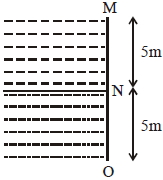
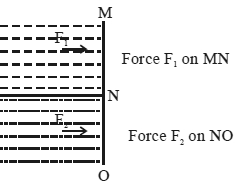
Two liquids of densities $\rho_{1}$ and $\rho_{2}\left(\rho_{2}=2 \rho_{1}\right)$ are filled up behind a square wall of side $10\; \mathrm{m}$ as shown in figure. Each liquid has a height of $5 \;\mathrm{m} .$ The ratio of the forces due to these liquids exerted on upper part $MN$ to that at the lower pait $NO$ is (Assume that the liquids are not mixing)
JEE MAIN 2020, Medium


Download our appand get started for free
Experience the future of education. Simply download our apps or reach out to us for more information. Let's shape the future of learning together!No signup needed.*
Similar Questions
- 1View SolutionSelect the correct statement regarding stream line flow
- 2View SolutionIf there were no gravity. which of the following will not be there for a fluid?
- 3The value of $g $ at a place decreases by $ 2\%.$ The barometric height of mercuryView Solution
- 4The velocity of upper layer of water in a river is $36 kmh ^{-1}$. Shearing stress between horizontal layers of water is $10^{-3} Nm ^{-2}$. Depth of the river is $m$. (Co-efficiency of viscosity of water is $10^{-2} \,Pa . s$ )View Solution
- 5A solid sphere, of radius $R$ acquires a terminal velocity $\nu_1 $ when falling (due to gravity) through a viscous fluid having a coefficient of viscosity $\eta $. The sphere is broken into $27$ identical solid spheres. If each of these spheres acquires a terminal velocity, $\nu_2$, when falling through the same fluid, the ratio $(\nu_1/\nu_2)$ equalsView Solution
- 6A water barrel stands on a table of height $h$. If a small hole is punched in the side of the barrel at its base, it is found that the resultant stream of water strikes the ground at a horizonatal distance $R$ from the barrel. The depth of water in the barrel isView Solution
- 7The Bhagirathi and the Alaknanda merge at Deoprayag to form the Ganga with their speeds in the ratio $1: 1: 5$. The cross-sectional areas of the Bhagirathi, the Alaknanda and the Ganga are in the ratio $1: 2: 3$. Assuming streamline flow, the ratio of the speed of Ganga to that of the Alaknanda isView Solution
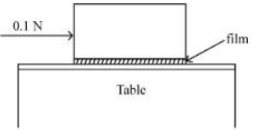
- 8A metal block of base area $0.20\,m ^2$ is placed on a table, as shown in figure. A liquid film of thickness $0.25\,mm$ is inserted between the block and the table. The block is pushed by a horizontal force of $0.1\,N$ and moves with a constant speed. If the viscosity of the liquid is $5.0 \times 10^{-3} \;Pa-s$, the speed of block is $.........\times 10^{-3}\,m / s$View Solution
- 9The diameter of an air bubble which was initially $2\,mm$, rises steadily through a solution of density $1750\,kg\,m\,m ^{-3}$ at the rate of $0.35\,cms ^{-1}$. The coefficient of viscosity of the solution is poise (in nearest integer). (the density of air is negligible).View Solution
- 10View SolutionAs the temperature of water increases, its viscosity