A capacitor $4\,\mu F$ charged to $50\, V$ is connected to another capacitor of $2\,\mu F$ charged to $100 \,V$ with plates of like charges connected together. The total energy before and after connection in multiples of $({10^{ - 2}}\,J)$ is
Diffcult
Download our app for free and get started
(a) The total energy before connection
$ = \frac{1}{2} \times 4 \times {10^{ - 6}} \times {(50)^2} + \frac{1}{2} \times 2 \times {10^{ - 6}} \times {(100)^2}$
$ = 1.5 \times {10^{ - 2}}\,J$
When connected in parallel
$4 \times 50 + 2 \times 100 = 6 \times V$ $==>$ $V = \frac{{200}}{3}$
Total energy after connection
$ = \frac{1}{2} \times 6 \times {10^{ - 6}} \times {\left( {\frac{{200}}{3}} \right)^2} = 1.33 \times {10^{ - 2}}\,J$
$ = \frac{1}{2} \times 4 \times {10^{ - 6}} \times {(50)^2} + \frac{1}{2} \times 2 \times {10^{ - 6}} \times {(100)^2}$
$ = 1.5 \times {10^{ - 2}}\,J$
When connected in parallel
$4 \times 50 + 2 \times 100 = 6 \times V$ $==>$ $V = \frac{{200}}{3}$
Total energy after connection
$ = \frac{1}{2} \times 6 \times {10^{ - 6}} \times {\left( {\frac{{200}}{3}} \right)^2} = 1.33 \times {10^{ - 2}}\,J$

Download our appand get started for free
Experience the future of education. Simply download our apps or reach out to us for more information. Let's shape the future of learning together!No signup needed.*
Similar Questions
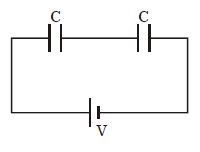
- 1Initially the circuit is in steady state. Now one of the capacitor is filled with dielectric of dielectric constant $2$ . Find the heat loss in the circuit due to insertion of dielectricView Solution
- 2Electric potential at a point $P$ due to a point charge of $5 \times 10^{-9}\; C$ is $50 \;V$. The distance of $P$ from the point charge is ......... $cm$View Solution
(Assume, $\frac{1}{4 \pi \varepsilon_0}=9 \times 10^{+9}\; Nm ^2 C ^{-2}$)
- 3$64$ small drops of mercury, each of radius $ r$ and charge $q$ coalesce to form a big drop. The ratio of the surface density of charge of each small drop with that of the big drop isView Solution
- 4Three condensers each of capacitance $2F$ are put in series. The resultant capacitance is.........$F$View Solution
- 5Three capacitors of capacitance $3\,\mu \,F,\,10\,\mu \,F\,$ and $15\,\mu \,F\,$ are connected in series to a voltage source of $100\,V$. The charge on $15\,\mu \,F\,$is.......$\mu C$View Solution
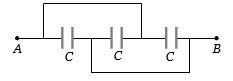
- 6Three equal capacitors, each with capacitance $C$ are connected as shown in figure. Then the equivalent capacitance between $A$ and $B$ isView Solution
- 7$27$ similar drops of mercury are maintained at $10 \,V$ each. All these spherical drops combine into a single big drop. The potential energy of the bigger drop is ....... times that of a smaller drop.View Solution
- 8View SolutionThree identical capacitors are combined differently. For the same voltage to each combination, the one that stores the greatest energy is
- 9Two parallel large thin metal sheets have equal surface charge densities $\left(\sigma=26.4 \times 10^{-12} C / m ^{2}\right)$ of same signs. The electric field between these sheet isView Solution
- 10A unit positive point charge of mass $m$ is projected with a velocity $V$ inside the tunnel as shown. The tunnel has been made inside a uniformly charged non conducting sphere. The minimum velocity with which the point charge should be projected such it can it reach the opposite end of the tunnel, is equal toView Solution
