A capacitor has air as dielectric medium and two conducting plates of area $12 \mathrm{~cm}^2$ and they are $0.6 \mathrm{~cm}$ apart. When a slab of dielectric having area $12 \mathrm{~cm}^2$ and $0.6 \mathrm{~cm}$ thickness is inserted between the plates, one of the conducting plates has to be moved by $0.2 \mathrm{~cm}$ to keep the capacitance same as in previous case. The dielectric constant of the slab is : (Given $\left.\epsilon_0=8.834 \times 10^{-12} \mathrm{~F} / \mathrm{m}\right)$
JEE MAIN 2024, Diffcult
Download our app for free and get started
$\frac{\mathrm{A} \varepsilon_{\mathrm{o}}}{\mathrm{d}}=\frac{\mathrm{A} \varepsilon_0}{\left(0.2+\frac{\mathrm{d}}{\mathrm{k}}\right)}$
$0.6=0.2+\frac{0.6}{\mathrm{k}}$
$\mathrm{k}=\frac{3}{2}$

Download our appand get started for free
Experience the future of education. Simply download our apps or reach out to us for more information. Let's shape the future of learning together!No signup needed.*
Similar Questions
- 1The dielectric constant $k$ of an insulator cannot beView Solution
- 2The area of the plates of a parallel plate condenser is $A$ and the distance between the plates is $10\,mm$. There are two dielectric sheets in it, one of dielectric constant $10$ and thickness $6\,mm$ and the other of dielectric constant $5$ and thickness $4\,mm$. The capacity of the condenser isView Solution
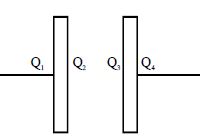
- 3In an insulated parallel-plate capacitor of capacitance $C$, the four surfaces have charges $Q_1, Q_2, Q_3$ and $Q_4$ as shown. The potential difference between the plate isView Solution
- 4A hollow metal sphere of radius $5\, cm$ is charged so that the potential on its surface is $10\, V$. The potential at the centre of the sphere isView Solution
- 5The charge given to a hollow sphere of radius $10\, cm$ is $3.2×10^{-19}\, coulomb$. At a distance of $4\, cm$ from its centre, the electric potential will beView Solution
- 6Eight drops of mercury of equal radii possessing equal charges combine to form a big drop. Then the capacitance of bigger drop compared to each individual small drop is........$times$View Solution
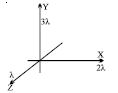
- 7The diagram shows three infinitely long uniform line charges placed on the $X, Y $ and $Z$ axis. The work done in moving a unit positive charge from $(1, 1, 1) $ to $(0, 1, 1) $ is equal toView Solution
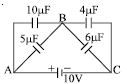
- 8In the circuit shown in figure, four capacitors are connected to a battery. The maximum energy is stored in the capacitor of.....$\mu F$View Solution
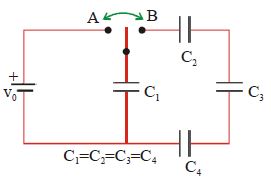
- 9The four identical capacitors in the circuit shown below are initially uncharged. The switch is then thrown first to position $A$, and then to position $B$. After this is done:View Solution
Note: $V_{1,2,3,4}$ are the potential differences across $C_{1,2,3,4}$ and $Q_{1,2,3,4}$ are the final charges stored in $C_{1,2,3,4}$ respectively.
- 10A $12\,pF$ capacitor is connected to a $50\,V$ battery. How much electrostatic energy is stored in the capacitorView Solution