Question
A capacitor is a device to store energy. The process of charging up a capacitor involves the transferring of electric charges from its one place to another. This work done in charging the capacitor is stored as its electrical potential energy.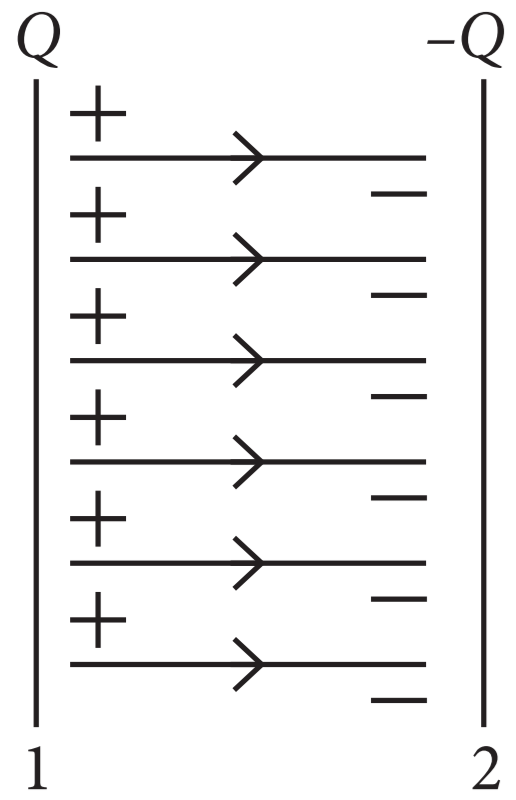
If $q$ is the charge and $V$ is the potential difference across a capacitor at any instant during its charging, then small work done in storing an additional small charge $dq$ against the repulsion of charge $q$ already stored on it is $\text{dW}=\text{V.dq}=(\frac{\text{q}}{\text{C}})\text{dq}.$
If $q$ is the charge and $V$ is the potential difference across a capacitor at any instant during its charging, then small work done in storing an additional small charge $dq$ against the repulsion of charge $q$ already stored on it is $\text{dW}=\text{V.dq}=(\frac{\text{q}}{\text{C}})\text{dq}.$
- A system of $2$ capacitors of capacitance $2\mu\text{F}$ and $4\mu\text{F}$ is connected in series across a potential difference of $6 V$. The energy stored in the system is:
- $3\mu\text{J}$
- $24\mu\text{J}$
- $30\mu\text{J}$
- $108\mu\text{J}$
- A capacitor of capacitance of $10\mu\text{F}$ is charged to $10V$. The energy stored in it is:
- $100\mu\text{J}$
- $500\mu\text{J}$
- $1000\mu\text{J}$
- $1\mu\text{J}$
- A parallel plate air capacitor has capacity $C$ farad, potential $V$ volt and energy $E$ joule. When the gap between the plates is completely filled with dielectric:
- Both $V$ and $E$ increase.
- Both $V$ and $E$ decrease.
- $V$ decreases $,E$ increases.
- $V$ increases $,E$ decreases.
- A capacitor with capacitance $5\mu\text{F}$ s charged to $5\mu\text{C}.$ If the plates are pulled apart to reduce the capacitance to $2\mu\text{F},$ how much work is done?
- $6.25 \times 10^{-6}J$
- $3.75 \times 10^{-6}J$
- $2.16 \times 10^{-6}J$
- $2.55 \times 10^{-6}J$
- A metallic sphere ofradius $18\ cm$ has been given a charge of $5 \times 10^{-6}C$. The energy of the charged conductor is:
- $0.2J$
- $0.6J$
- $1.2J$
- $2.4J$