Question
When the frequency of ac supply is such that the inductive reactance and capacitive reactance become equal, the impedance of the series $\text{LCR}$ circuit is equal to the ohmic resistance in the circuit. Such a series $\text{LCR}$ circuit is known as resonant series $\text{LCR}$ circuit and the frequency of the ac supply is known as resonant frequency. Resonance phenomenon is exhibited by a circuit only if both Land Care present in the circuit. We cannot have resonance in a $\text{RL}$ or $\text{RC}$ circuit.
A series $\text{LCR}$ circuit with $L = 0.12H, C = 480\ nF, \text{R} = 23\Omega$ is connected to a $230V$ variable frequency supply.
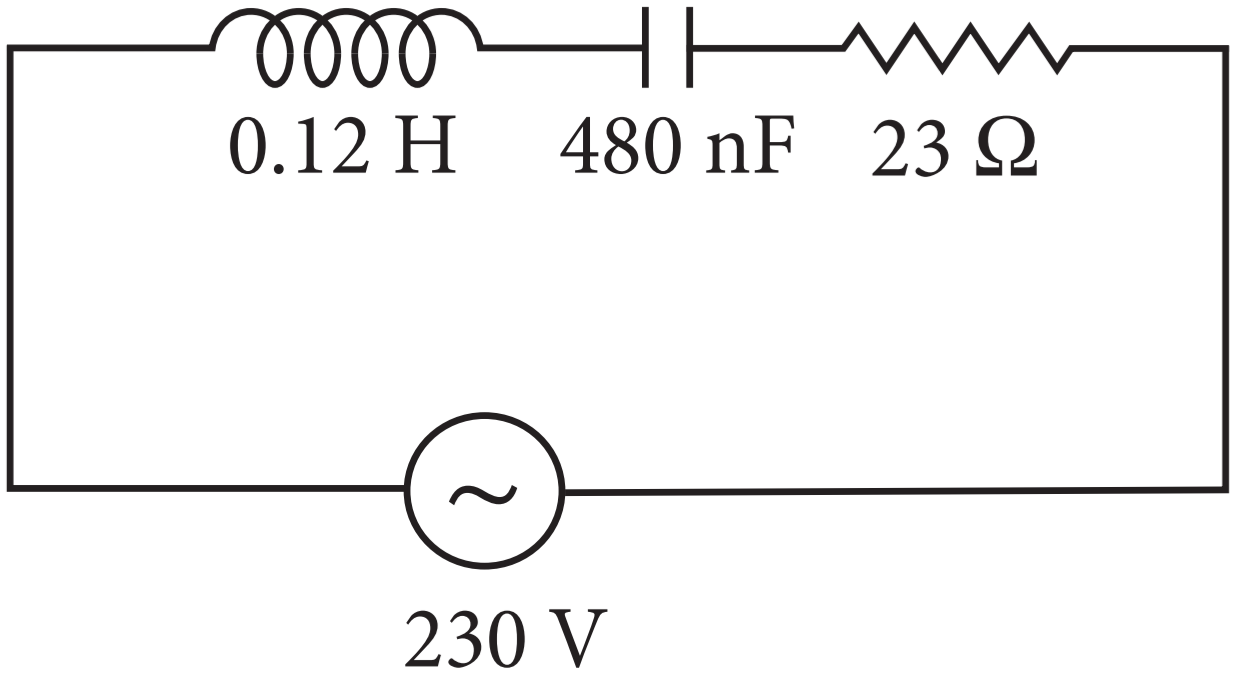
  1. Find the value of source frequency for which current amplitude is maximum.
  1. $222.32\ Hz$
  2. $550.52\ Hz$
  3. $663.48\ Hz$
  4. $770\ Hz$
  1. The value of maximum current is:
  1. $14.14A$
  2. $22.52A$
  3. $50.25A$
  4. $47.41A$
  1. The value of maximum power is:
  1. $2200W$
  2. $2299.3W$
  3. $5500W$
  4. $4700W$
  1. What is the $Q-$factor of the given circuit?
  1. $25$
  2. $42.21$
  3. $35.42$
  4. $21.74$
  1. At resonance which of the following physical quantity is maximum?
  1. Impedance
  2. Current
  3. Both $(a)$ and $(b)$
  4. Neither $(a)$ nor $(b)$

Answer

  1. $(c)\ 663.48\ Hz$
Here, $L = 0.12H, e = 480\ nF = 480 \times 10^{-9}F$
$\text{R} = 23\Omega, V = 230V$
$\text{V}_0=\sqrt{2}\times230=325.22\text{V}$
$\text{I}_0=\frac{\text{V}_0}{\sqrt{\text{R}^2+\Big(\omega\text{L}-\frac{1}{\omega\text{C}}\Big)^2}}$
At resonance, $\omega\text{L}-\frac{1}{\omega\text{C}}=0$
$\omega=\frac{1}{\sqrt{\text{LC}}}=\frac{1}{\sqrt{0.12\times480\times10^9}}=4166.67\ \text{rad}\ \text{s}^{-1}$
$\upsilon_\text{R}=\frac{4166.67}{2\times3.14}=663.48\text{H}_\text{z}$
  1. $(a)\ 14.14A$
Current, $\text{I}_0=\frac{\text{V}_0}{\text{R}}=\frac{325.22}{23}=14.14\text{A}$
  1. $(b)\ 2299.3W$
Maximum power, $\text{P}_\text{max}=\frac{1}{2}(\text{I}_0)^2\text{R}$
$=\frac{1}{2}\times(14.14)^2\times23=2299.3\text{W}$
  1. $(d)\ 21.74$
Quality factor, $\text{Q}=\frac{\text{X}_\text{R}}{\text{R}}=\frac{\omega_\text{r}\text{L}}{\text{R}}$
$=\frac{4166.67\times0.12}{23}=21.74$
  1. $(b)$ Current

Need a full question paper?

Generate a complete, print-ready paper with questions like this in minutes — across 16+ boards, with answer keys.

Start Generating Free

Similar questions

Coulomb's law states that the electrostatic force of attraction or repulsion acting between two stationary point charges is given by
Image
where $F$ denotes the force between two charges $q _1$ and $q _2$ separated by a distance r in free space, $\varepsilon_0$ is a constant known as the permittivity of free space.
Free space is a vacuum and may be taken to be air practically.
If free space is replaced by a medium, then $\varepsilon_0$ is replaced by $\left(\varepsilon_0 k\right)$ or $\left(\varepsilon_0 \varepsilon_r\right)$ where $k$ is known as dielectric constant or relative permittivity.
$(i)$ In coulomb's law, $F =k \frac{q_1 q_2}{r^2}$, then on which of the following factors does the proportionality constant k depends?
$(a)$ Nature of the medium between the two charges
$(b)$ Distance between the two charges
$(c)$ Electrostatic force acting between the two charges
$(d)$ Magnitude of the two charges

$(ii)$ Dimensional formula for the permittivity constant $\varepsilon_0$ of free space is
$(a) \left[ M ^{-1} L^3 T^2 A^2\right]$
$(b) \left[ ML ^{-3} T^4 A^2\right]$
$(c) \left[ M ^{-1} L^{-3} T^4 A^2\right]$
$(d) \left[ ML ^{-3} T^4 A^{-2}\right]$

$(iii)$ The force of repulsion between two charges of $1 C$ each, kept $1m$ apart in vaccum is
$(a) \frac{1}{9 \times 10^9} N$
$(b) \frac{1}{9 \times 10^{12}} N$
$(c) 9 \times 10^7 N$
$(d) 9 \times 10^9 N$

$(iv)$ Two identical charges repel each other with a force equal to $10$ mgwt when they are $0.6 m$ apart in air. ( $g =$ $10 m s ^{-2} )$. The value of each charge is
$(a) 2 mC$
$(b) 2 \times 10^{-7} mC$
$(c) 2 \mu C$
$(d) 2 nC$
OR
Coulomb's law for the force between electric charges most closely resembles with
$(a)$ law of conservation of energy
$(b)$ Newton's $2^{nd}$ law of motion
$(c)$ law of conservation of charge .
$(d)$ Newton's law of gravitation
A player hits a baseball at some angle. The ball goes high up in space. The player runs and catches the ball before it hits the ground. Which of the two (the player or the ball) has greater displacement?
LASER: Electromagnetic radiation is a natural phenomenon found in almost all areas of daily life, from radio waves to sunlight to x-rays. Laser radiation - like all light - is also a form of electromagnetic radiation. Electromagnetic radiation that has a wavelength between 380 nm and 780 nm is visible to the human eye and is commonly referred to as light. At wavelengths longer than 780 nm, optical radiation is termed infrared (IR) and is invisible to the eye. At wavelengths shorter than 380 nm, optical radiation is termed ultraviolet (UV) and is also invisible to the eye. The term laser light refers to a much broader range of the electromagnetic spectrum that just the visible spectrum, anything between 150 nm up to 11000 nm (i.e., from the UV up to the far IR). The term laser is an acronym which stands for light amplification by stimulated emission of radiation. Einstein explained the stimulated emission. In an atom, electron may move to higher energy level by absorbing a photon. When the electron comes back to the lower energy level it releases the same photon. This is called spontaneous emission. This may also so happen that the excited electron absorbs another photon, releases two photons and returns to the lower energy state. This is known as stimulated emission.
Laser emission is therefore a light emission whose energy is used, in lithotripsy, for targeting and ablating the tone inside human body organ.
Apart from medical usage, laser is used for optical disk drive, printer, barcode reader etc.
(i) What is the full form of LASER?
(a) light amplification by simultaneous emission of radiation
(b) light amplified by synchronous emission of radiation
(c) light amplified by stimulated emission of radiation
(d) light amplification by stimulated emission of radiation

(ii) The stimulated emission is the process of
(a) absorption of two photon when electron moves from lower to higher energy level
(b) release of two photons by absorbing one photon when electron comes back from higher to lower energy level
(c) release of a photon when electron comes back from higher to lower energy level
(d) absorption of a photon when electron moves from lower to higher energy level

(iii) What is the range of amplitude of LASER?
(a) 150 nm - 400 nm
(b) 700 nm - 11000 nm
(c) Both 150 nm - 400 nm and 700 nm 11000 nm
(d) 800 nm - 12000 nm
OR
LASER is used in
(a) Ionization
(b) Transmitting Satellite signal
(c) Optical disk drive
(d) Radio communication

(iv) Lithotripsy is
(a) Laboratory application
(b) An industrial application
(c) A medical application
(d) Process control application 
To keep valuable instruments away from the earth's magnetic field, they are enclosed in iron boxes. Explain.
Cloudy nights are warmer than the nights with clean sky. Explain.
Draw the graph of deviation angle $(\delta)$ versus incidence angle $(i)$ and derive the formula for refractive index $n_{21}=\frac{\sin \left(\frac{A+D_m}{2}\right)}{\sin \left(\frac{A}{2}\right)}$ for the material of prism.
Calculate the height of the potential barrier for a head-on collision of two deuterons.
(Hint: The height of the potetnial barrier is given by the Coulomb repulsion between the two deuterons when they just touch each other. Assume that they can be taken as hard spheres of radius 2.0 fm.)
Shows a rod PQ of length 20.0cm and mass 200g suspended through a fixed point O by two threads of lengths 20.0cm each. A magnetic field of strength 0.500T exists in the vicinity of the wire PQ, as shown in the figure. The wires connecting PQ with the battery are loose and exert no force on PQ.
  1. Find the tension in the threads when the switch S is open.
  2. A current of 2.0A is established when the switch S is closed. Find the tension in the threads now.
At a prayer meeting, the disciples sing JAI-RAM JAI-RAM. The sound amplified by a loudspeaker comes back after reflection from a building at a distance of 80m from the meeting. What maximum time interval can be kept between one JAI-RAM and the next JAI-RAM so that the echo does not disturb a listener sitting in the meeting. Speed of sound in air is 320m/s.
Why don't we have interference when two candles are placed close to each other and the intensity is seen at a distant screen? What happens if the candles are replaced by laser sources?