Question
A capacitor is a device to store energy. The process of charging up a capacitor involves the transferring of electric charges from its one place to another. This work done in charging the capacitor is stored as its electrical potential energy.
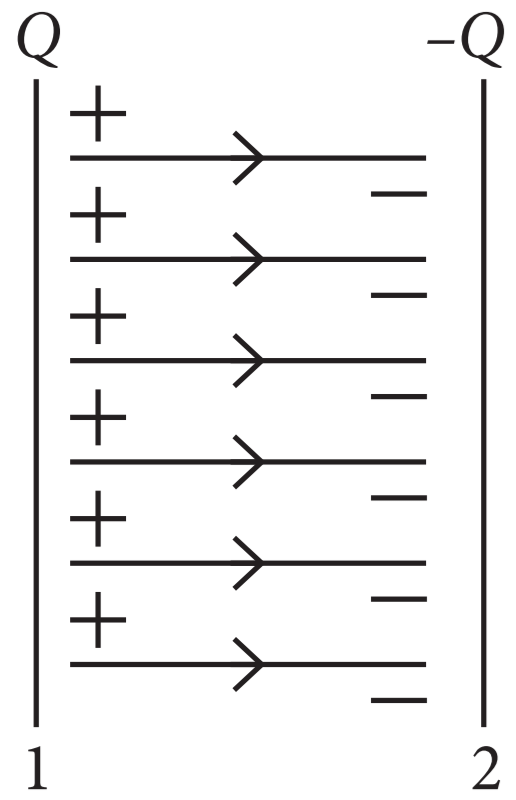
If q is the charge and V is the potential difference across a capacitor at any instant during its charging, then small work done in storing an additional small charge dq against the repulsion of charge q already stored on it is $\text{dW}=\text{V.dq}=(\frac{\text{q}}{\text{C}})\text{dq}.$

  1. A system of 2 capacitors of capacitance $2\mu\text{F}$ and $4\mu\text{F}$ is connected in series across a potential difference of 6 V. The energy stored in the system is:
  1. $3\mu\text{J}$
  2. $24\mu\text{J}$
  3. $30\mu\text{J}$
  4. $108\mu\text{J}$
  1. A capacitor of capacitance of $10\mu\text{F}$ is charged to 10V. The energy stored in it is:
  1. $100\mu\text{J}$
  2. $500\mu\text{J}$
  3. $1000\mu\text{J}$
  4. $1\mu\text{J}$
  1. A parallel plate air capacitor has capacity C farad, potential V volt and energy E joule. When the gap between the plates is completely filled with dielectric:
  1. Both V and E increase.
  2. Both V and E decrease.
  3. V decreases, E increases.
  4. V increases, E decreases.
  1. A capacitor with capacitance $5\mu\text{F}$ s charged to $5\mu\text{C}.$ If the plates are pulled apart to reduce the capacitance to $2\mu\text{F},$ how much work is done?
  1. 6.25 × 10-6J
  2. 3.75 × 10⁻⁶J
  3. 2.16 × 10⁻⁶J
  4. 2.55 × 10⁻⁶J
  1. A metallic sphere ofradius 18cm has been given a charge of 5 × 10-6C. The energy of the charged conductor is:
  1. 0.2J
  2. 0.6J
  3. 1.2J
  4. 2.4J

Answer

  1. (b) $24\mu\text{J}$

Explanation:

As, $\text{C}_1=2\mu\text{F},\text{C}_2=4\mu\text{F}$

ln series combination, the equivalent capacitance will be, 

$\text{C}=\frac{\text{C}_1\text{C}_2}{\text{C}_1+\text{C}_2}=\Big(\frac{2\times4}{2+4}\Big)\mu\text{F}$

$=\frac{4}{3}\mu\text{F}$

Potential difference applied, V = 6V

Energy stored in the system, $\text{U}=\frac{1}{2}\text{CV}^2$

$=\frac{1}{2}\times\frac{4}{3}\times10^{-6}\times(6)^2$

$\text{J}=24\mu\text{J}.$

  1. (b) $500\mu\text{J}$

​​​​​​​​​​​​​​Explanation:

The energy stored in a capacitor is

$\text{U}=\frac{1}{2}\text{CV}^2$

$=\frac{1}{2}\times(10\times10^{-6})(10)^2=500\mu\text{J}.$

  1. (b) Both V and E decrease.

​​​​​​​​​​​​​​​​​​​​​Explanation:

When the gap between the plates is completely filled with dielectric of dielectric constant K, then potential is:

$\text{V}=\frac{\text{Qd}}{\text{A}\in_0\text{K}}$ (i)

and electric field is

$\text{E}=\frac{\text{Q}}{\text{A}\in_0\text{K}}$ (ii)

From equations (i) and (ii), both electric field and potential decrease.

  1. (b) 3.75 × 10⁻⁶J

​​​​​​​​​​​​​​​​​​​​​​​​​​​​Explanation:

Work done $=\text{U}_\text{f}-\text{U}_\text{i}=\frac{1}{2}\frac{\text{q}^2}{\text{C}_\text{f}}-\frac{1}{2}\frac{\text{q}^2}{\text{C}_\text{i}}$

$=\frac{\text{q}^2}{2}\Big[\frac{1}{\text{C}_\text{f}}-\frac{1}{\text{C}_\text{i}}\Big]$

$=\frac{(5\times10^{-6})^2}{2}\Big[\frac{1}{2\times10^{-6}}-\frac{1}{5\times10^{-6}}\Big]$

= 3.75 × 10⁻⁶J

  1. (b) 0.6J

​​​​​​​​​​​​​​​​​​​​​​​​​​​​​​​​​​​Explanation:

Here r = 18cm = 18 × 10-2m, q = 5 × 10⁻⁶C

As, $\text{C}=4\pi\in_0\text{r}=\frac{18\times10^{-2}}{9\times10^9}=2\times10^{-11}\text{F}$

Energy of charged conductor is

$\text{U}=\frac{\text{q}^2}{\text{2C}}=\frac{(5\times10^{-6})^2\text{C}}{2\times2\times10^{-11}\text{F}}=0.625\text{J}.$

Need a full question paper?

Generate a complete, print-ready paper with questions like this in minutes — across 16+ boards, with answer keys.

Start Generating Free

Similar questions

A magnetic dipole of magnetic moment 1.44A-m2 is placed horizontally with the north pole pointing towards north. Find the position of the neutral point if the horizontal component of the earth's magnetic field is $18 \mu\text{T}.$
Show that the magnetic field at a point due to a magnetic dipole is perpendicular to the magnetic axis if the line joining the point with the centre of the dipole makes an angle of $\tan^{-1}(\sqrt{2})$ with the magnetic axis.
A short magnet oscillates in an oscillation magnetometern with a time period of 0.10s where the earth's horizontal magnetic field is $24\mu\text{T}.$ A downward current of 18 A is established in a vertical wire placed 20cm east of the magnet. Find the new time period.
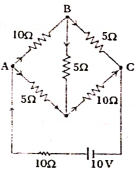
Determine the current in each branch of the network shown in figure.
Image
A metal rod is placed along the axis of a solenoid carrying a high-freqμency alternating current. It is found that the rod gets heated. Explain why the rod gets heated.
Explain the forward bias characteristics of $p-n$ junction diode with necessary graph.
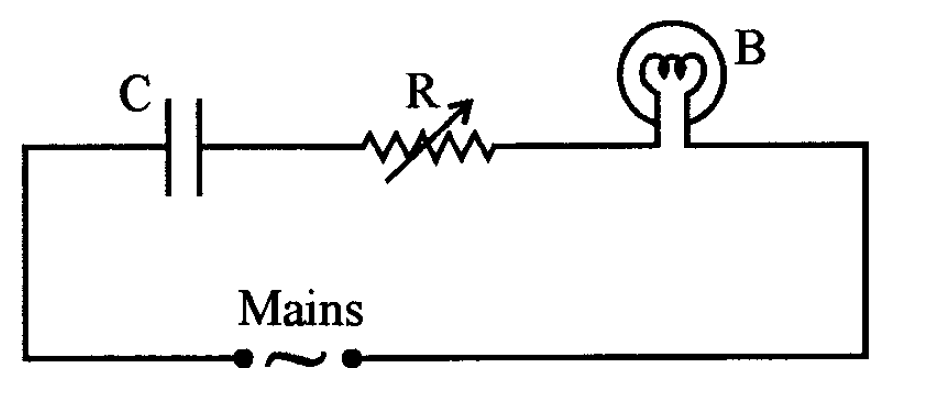
A capacitor'C', a variable resistor 'R' and a bulb 'B' are connected in series to the ac mains in circuit as shown. The bulb glows with some brightness. How will the glow of the bulb change if (i) a dielectric slab is introduced between the plates of the capacitor, keeping resistance R to be the same; (ii) the resistance R is increased keeping the same capacitance?

An electron in hydrogen atom revolving in a radius of $5.29 \times 10^{11} m$ around the nucleus. According to the condition of Bohr's allowed electron orbits, find the principle quantum number corresponds to this orbit.
$\begin{array}{l}
h=6.625 \times 10^{-34} Js, e=1.6 \times 10^{-19} C \\
\varepsilon_0=8.85 \times 10^{-12} MKS, m=9.1 \times 10^{-31} kg \text { Find out conclusion from your answe }
\end{array}$
Distance between two successive bright or dark fringes is called fringe width.
$\beta=\text{Y}_\text{n+1}-\text{Y}_\text{n}=\frac{(\text{n}+1)\lambda\text{D}}{\text{d}}-\frac{\text{n}\lambda\text{D}}{\text{d}}=\frac{\lambda\text{D}}{\text{d}}$
Fringe width is independent of the order of the maxima. If whole apparatus is immersed in liquid of refractive index $\mu$ then $\beta=\frac{\lambda\text{D}}{\mu\text{d}}$ (fringe width decreases). Angular fringe width $(\theta)$ is the angular separation between two consecutive maxima or minima
$\theta=\frac{\beta}{\text{D}}=\frac{\lambda}{\text{d}}$
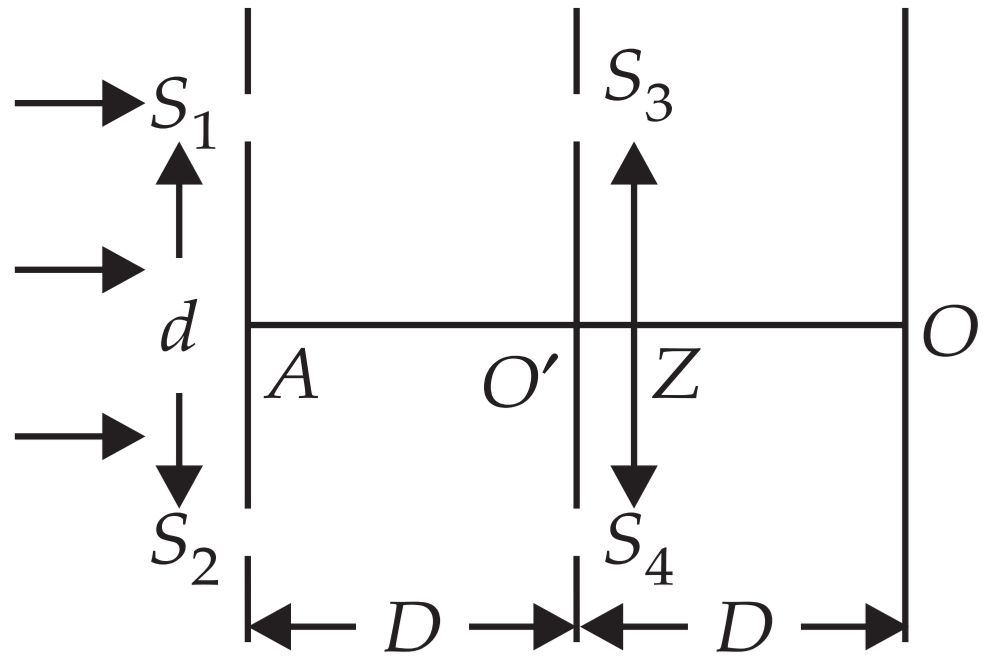
ln the arrangement shown in figure, slit S3 and S4 are having a variable separation Z. Point O on the screen is at the common perpendicular bisector of S1S2 and S3S4.

  1. The maximum number of possible interference maxima for slit separation equal to twice the wavelength in Young's double-slit experiment, is:
  1. Infinite
  2. Five
  3. Three
  4. Zero
  1. ln Young's double - slit experiment if yellow light is replaced by blue light, the interference fringes become.
  1. Wider
  2. Brighter
  3. Narrower
  4. Darker
  1. ln Young's double slit experiment, if the separation between the slits is halved and the distance between the slits and the screen is doubled, then the fringe width compared to the unchanged one will be.
  1. Unchanged
  2. Halved
  3. Doubled
  4. Quadrupled
  1. When the complete Young's double slit experiment is immersed in water, the fringes.
  1. Remain unaltered.
  2. Become wider.
  3. Become narrower.
  4. Disappear.
  1. ln a two slit experiment with white light, a white fringe is observed on a screen kept behind the slits. When the screen is moved away by 0.05m, this white fringe.
  1. Does not move at all.
  2. Gets displaced from its earlier position.
  3. Becomes coloured.
  4. Disappears.
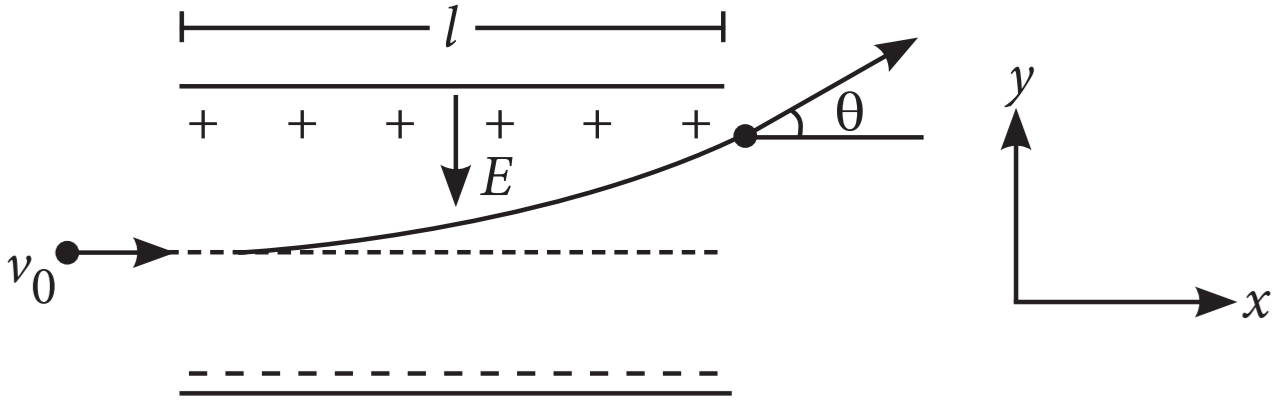
When a charged particle is placed in an electric field, it experiences an electrical force. If this is the only force on the particle, it must be the net force. The net force will cause the particle to accelerate according to Newton's second law. So $\vec{\text{F}}_\text{e}=\text{q}\vec{\text{E}}=\text{m}\vec{\text{a}}$

If $\vec{\text{E}}$ is uniform, then $\vec{\text{a}}$ is constant and $\vec{\text{a}}=\text{q}\vec{\text{E}}\text{/ m.}$ If the particle has a positive charge, its acceleration is in the direction of the field. If the particle has a negative charge, its acceleration is in the direction opposite to the electric field. Since the acceleration is constant, the kinematic equations can be used.

  1. An electron of mass m, charge e falls through a distance h metre in a uniform electric field E. Then time of fall,
  1. $\text{t}=\sqrt{\frac{\text{2hm}}{\text{eE}}}$

  2. $\text{t}=\frac{\text{2hm}}{\text{eE}}$

  3. $\text{t}=\sqrt{\frac{\text{2eE}}{\text{hm}}}$

  4. $\text{t}=\frac{\text{2eE}}{\text{hm}}$

  1. An electron moving with a constant velocity v along X-axis enters a uniform electric field applied along Y-axis. Then the electron moves:
  1. With uniform acceleration along Y-axis
  2. Without any acceleration along Y-axis
  3. In a trajectory represented as y = ax2
  4. In a trajectory represented as y = ax
  1. Two equal and opposite charges of masses m1 and m2 are accelerated in an uniform electric field through the same distance. What is the ratio of their accelerations if their ratio of masses is $\frac{\text{m}_1}{\text{m}_2}=0.5?$
  1. $\frac{\text{a}_1}{\text{a}_2}=2$

  2. $\frac{\text{a}_1}{\text{a}_2}=0.5$

  3. $\frac{\text{a}_1}{\text{a}_2}=3$

  4. $\frac{\text{a}_1}{\text{a}_2}=1$

  1. A particle of mass m carrying charge q is kept at rest in a uniform electric field E and then released. The kinetic energy gained by the particle, when it moves through a distance y is:
  1. $\frac{1}{2}\text{qEy}^2$
  2. qEy
  3. qEy2
  4. qE2y
  1. A charged particle is free to move in an electric field. It will travel:
  1. Always along a line of force.
  2. Along a line of force, if its initial velocity is zero.
  3. Along a line of force, if it has some initial velocity in the direction of an acute angle with the line of force.
  4. None of these.