A capacitor is charged to $200\, volt$ it has $0.1$ coulomb charge. When it is discharged, energy will be.....$J$
Medium


Download our appand get started for free
Experience the future of education. Simply download our apps or reach out to us for more information. Let's shape the future of learning together!No signup needed.*
Similar Questions
- 1Two parallel plate capacitor with different plate seperation but the same capacitance are connected in series to a battery. Both capacitors are filled with air. The quantity that is $NOT$ the same for both the capacitors when they are fully charged isView Solution
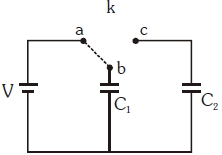
- 2Two Identical capacttors $\mathrm{C}_{1}$ and $\mathrm{C}_{2}$ of equal capacitance are connected as shown in the circult. Terminals $a$ and $b$ of the key $k$ are connected to charge capacitor $\mathrm{C}_{1}$ using battery of $emf \;V\; volt$. Now disconnecting $a$ and $b$ the terminals $b$ and $c$ are connected. Due to this, what will be the percentage loss of energy?.....$\%$View Solution
- 3The distance between the plates of a parallel plate capacitor is $d$. A metal plate of thickness $d/2$ is placed between the plates. The capacitance would then beView Solution
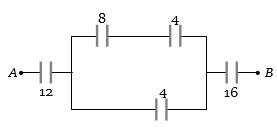
- 4What is the equivalent capacitance between $A$ and $B$ in the given figure (all are in farad)View Solution
- 5The electric potential at a point on the axis of an electric dipole depends on the distance $r$ of the point from the dipole asView Solution
- 6A parallel-plate capacitor is connected to a resistanceless circuit with a battery until the capacitor is fully charged. The battery is then disconnected from the circuit and the plates of the capacitor are moved to half of their original separation using insulated gloves. Let $V_{new}$ be the potential difference across the capacitor plates when the plates have moved. Let $V_{old}$ be the potential difference across the capacitor plates when they were connected to the battery $\frac{V_{new}}{V_{old}}=$......View Solution
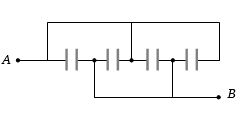
- 7Four condensers are joined as shown in the adjoining figure. The capacity of each is $8\,\mu F$. The equivalent capacity between the points $A$ and $B$ will be......$\mu F$View Solution
- 8Two equal charges $q$ of opposite sign separated by a distance $2a$ constitute an electric dipole of dipole moment $p$. If $P$ is a point at a distance $r$ from the centre of the dipole and the line joining the centre of the dipole to this point makes an angle $\theta $ with the axis of the dipole, then the potential at $P$ is given by $(r > > 2a)$ (Where $p = 2qa$)View Solution
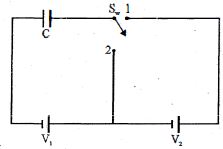
- 9The switch $S_w$ is shifted from position $1$ to position $2$ as shown in the figure. Heat generated in the circuit isView Solution
- 10Two large vertical and parallel metal plates having a separation of $1 \ cm$ are connected to a $DC$ voltage source of potential difference $X$. A proton is released at rest midway between the two plates. It is found to move at $45^{\circ}$ to the vertical $JUST$ after release. Then $X$ is nearlyView Solution