A capacitor of $10\,\mu F$ charged up to $250\, volts$ is connected in parallel with another capacitor of $5\,\mu F$ charged up to $100\, volts$. The common potential is.....$V$
Medium
Download our app for free and get started
(d) $V = \frac{{{C_1}{V_1} + {C_2}{V_2}}}{{{C_1} + {C_2}}} = \frac{{10 \times 250 + 5 \times 100}}{{10 + 5}} = \,200\,volt$

Download our appand get started for free
Experience the future of education. Simply download our apps or reach out to us for more information. Let's shape the future of learning together!No signup needed.*
Similar Questions
- 1A capacitor of capacity ${C_1}$ is charged upto $V$ volt and then connected to an uncharged capacitor of capacity ${C_2}$. Then final potential difference across each will beView Solution
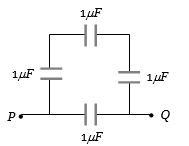
- 2Four capacitors are connected as shown in the equivalent capacitance between the points $P$ and $Q$ is.......$\mu F$View Solution
- 3Find the potential $V$ of an electrostatic field $\vec E = a\left( {y\hat i + x\hat j} \right)$, where $a$ is a constant.View Solution
- 4Charge of $2Q$ and $-Q$ are placed on two plates of a parallel plate capacitor. If capacitance of capacitor is $C$, potential difference between the plates isView Solution
- 5A condenser of capacity ${C_1}$ is charged to a potential ${V_0}$. The electrostatic energy stored in it is ${U_0}$. It is connected to another uncharged condenser of capacity ${C_2}$ in parallel. The energy dissipated in the process isView Solution
- 6Ten charges are placed on the circumference of a circle of radius $R$ with constant angular separation between successive charges. Alternate charges $1,3,5,7,9$ have charge $(+q)$ each, while $2,4,6,8,10$ have charge $(-q)$ each. The potential $V$ and the electric field $E$ at the centre of the circle are respectivelyView Solution
(Take $V =0$ at infinity $)$
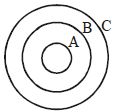
- 7Charges $Q, 2Q$ and $-Q$ are given to three concentric conducting shells $A, B$ and $C$ respectively as shown the ratio of charges on inner and outer surfaces of shell $C$ will beView Solution
- 8The distance between the two plates of a parallel plate capacitor is doubled and the area of each plate is halved. If $C$ is its initial capacitance, its final capacitance is equal toView Solution
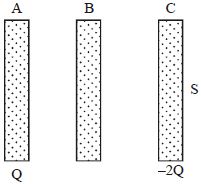
- 9Three identical metal plates with large surface areas are kept parallel to each other as shown in figure. The left most plates is given a charge $Q$ and the right most plate $C$ is given a charge $-2Q.$ The middle plate $B$ is neutral. Then the charge appearing on the outer surface $S$ of the plate $C$ is :-View Solution
- 10Four charges $2C, -3C, -4C$ and $5C$ respectively are placed at all the corners of a square. Which of the following statements is true for the point of intersection of the diagonals ?View Solution