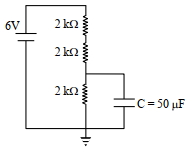
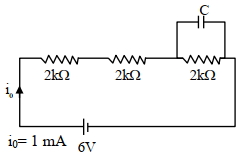
A capacitor of $50 \,\mu {F}$ is connected in a circuit as shown in figure. The charge on the upper plate of the capacitor is $......\,\mu {C} .$
JEE MAIN 2021, Medium


Download our appand get started for free
Experience the future of education. Simply download our apps or reach out to us for more information. Let's shape the future of learning together!No signup needed.*
Similar Questions
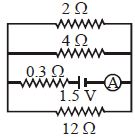
- 1In the circuit shown in the adjoining figure, the reading of ammeter $A$ is ................ $\mathrm{A}$View Solution
- 2A battery of $e.m.f.$ $3\, volt$ and internal resistance $1.0\, ohm$ is connected in series with copper voltameter. The current flowing in the circuit is $1.5\, amperes$. The resistance of voltameter will be ........... $ohm$View Solution
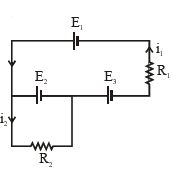
- 3The current $i_1$ and $i_2$ through the resistors $R_1(=10\,\Omega )$ and ${R_2}\left( { = 30\,\Omega } \right)$ in the circuit diagram with $E_1 = 3\,V$, $E_2 = 3\,V$ and $E_3 = 2\,V$ are respectivelyView Solution
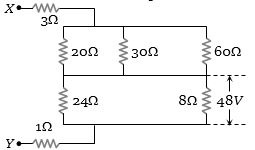
- 4The potential difference across $8\, ohm$ resistance is $48\, volt$ as shown in the figure. The value of potential difference across $X$ and $Y$ points will be ............. $volt$View Solution
- 5View SolutionThe positive temperature coefficient of resistance is for
- 6A battery of $3.0\, V$ is connected to a resistor dissipating $0.5\, W$ of power. If the terminal voltage of the battery is $2.5\, V$ the power dissipated within the internal resistance is$.......W$View Solution
- 7An electric lamp is marked $60\, W$, $ 230\, V$. The cost of $1\, kilowatt$ hour of power is Rs. $1.25$. The cost of using this lamp for $8$ hours is Rs. ................View Solution
- 8A $16\, \Omega$ wire is bend to form a square loop. A $9 \,{V}$ supply having internal resistance of $1 \,\Omega$ is connected across one of its sides. The potential drop across the diagonals of the square loop is $.......\,\times 10^{-1} \,{V}$View Solution
- 9An electric bulb is rated $220\, volt$ and $100\, watt$. Power consumed by it when operated on $110\, volt$ is ............. $watt$View Solution
- 10At what temperature will the resistance of a copper wire become three times its value at $0\,^oC$ ................. $^oC$ (Temperature coefficient of resistance for copper = $4 × 10^{-3} \,per\, \,^oC$ )View Solution