A capacitor of capacitance $C$ is charged with the help of a $200 \,V$ battery. It is then discharged through a small coil of resistance wire embedded in a thermally insulated block of specific heat capacity $2.5 \times 10^2 \,J / kg$ and mass $0.1 \,kg$. If the temperature of the block rises by $0.4 \,K$, the value of $C$ is
Easy


Download our appand get started for free
Experience the future of education. Simply download our apps or reach out to us for more information. Let's shape the future of learning together!No signup needed.*
Similar Questions
- 1The distance between the plates of a parallel plate condenser is $8\,mm$ and $P.D.$ $120\;volts$. If a $6\,mm$ thick slab of dielectric constant $6$ is introduced between its plates, thenView Solution
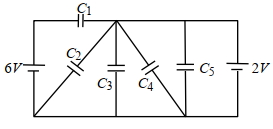
- 2In the following circuit $C_1=12 \mu F, C_2=C_3=4 \mu F$ and $C_4=C_5=2 \mu F$. The Charge stored in $C_3$ is. . . . . $\mu C$.View Solution
- 3A $10\,\mu F$ capacitor is charged to a potential difference of $1000\, V$. The terminals of the charged capacitor are disconnected from the power supply and connected to the terminals of an uncharged $6\, \mu F$ capacitor. What is the final potential difference across each capacitor?......$V$View Solution
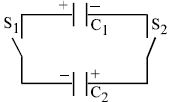
- 4Two capacitors $C_1 = 4\ \mu F$ and $C_2 = 2\ \mu F$ are charged to same potential $ V = 500\ Volt$, but with opposite polarity as shown in the figure. The switches $S_1$ and $S_2$ are closed.View Solution
- 5A charge of $40\,\mu \,C$ is given to a capacitor having capacitance $C = 10\,\mu \,F$. The stored energy in ergs isView Solution
- 6An infinite number of charges each equal to $0.2\,\mu C$ are arranged in a line at distances $1\,m, 2\,m, 4\,m, 8\,m......$ from a fixed point. The potential at fixed point is ......$kV$View Solution
- 7View SolutionA hollow closed conductor of irregular shape is given some charge. Which of the following statements are correct ?
- 8Two equal positive point charges are kept at points $A$ and $B$ . The electric potential, while moving from $A$ to $B$ along straight lineView Solution
- 9A pellet carrying a charge of $0.5$ coulomb is accelerated through a potential of $2000$ volts. It attains some kinetic energy equal toView Solution
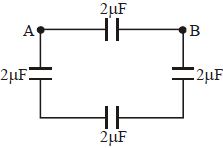
- 10The equivalent capacitance between the points $A$ and $B$ in the given diagram isView Solution