A car is moving on a horizontal circular road of radius $0.1 \,km$ with constant speed. If coefficient of friction between tyres of car and road is $0.4$, then speed of car may be ......... $m / s$ $\left(g=10 \,m / s ^2\right)$
Easy
Download our app for free and get started
(d)
Maximum speed for the circular road
$\frac{v_{\text {maximum }}^2}{r}=\mu g$
$V_{\text {maximum }}=\sqrt{\mu r g}$
$=\sqrt{0.4 \times 100 \times 10}=\sqrt{400}=20 \,m / s$

Download our appand get started for free
Experience the future of education. Simply download our apps or reach out to us for more information. Let's shape the future of learning together!No signup needed.*
Similar Questions
- 1A car of mass $1000\, kg$ negotiates a banked curve of radius $90\, m$ on a frictionless road. If the banking angle is $45^o $, the speed of the car is ....... $ms^{-1}$View Solution
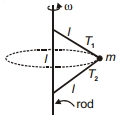
- 2In the figure, a ball of mass $m$ is tied with two strings of equal length as shown. If the rod is rotated with angular velocity $\omega$, thenView Solution
- 3A block of mass $m$ is placed on a surface having vertical cross section given by $y=x^2 / 4$. If coefficient of friction is $0.5$ , the maximum height above the ground at which block can be placed without slipping is:View Solution
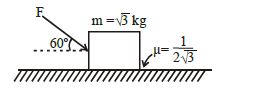
- 4What is the maximum value of the force $F$ such that the block shown in the arrangement does not move ....... $N$View Solution
- 5A ball of mass $0.1\, Kg$. is whirled in a horizontal circle of radius $1\, m$. by means of a string at an initial speed of $10\, R.P.M.$ Keeping the radius constant, the tension in the string is reduced to one quarter of its initial value. The new speed is ....... $r.p.m.$View Solution
- 6A block of mass $10\; \mathrm{kg}$ is in contact against the inner wall of a hollow cylindow cylindrical drum of radius $1 \;\mathrm{m}$. The coeffident of friction between the block and the inner wall of the cylinder is $0.1$. The minimum angular velocity needed for the cylinder to keep the block stationary when the cylinder is vertical and rotating about its axis, will be: ......$rad/s$ $\left(g-10 m / s^{2}\right)$View Solution
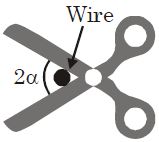
- 7Someone is using a scissors to cut a wire of circular cross section and negligible weight. The wire slides in the direction away from the hinge until the angle between the scissors blades becomes $2 \alpha$. The friction coefficient between the blades and the wire, is :-View Solution
- 8View SolutionThe limiting friction between two bodies in contact is independent of
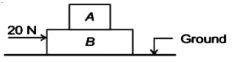
- 9Blocks shown in figure moves with constant velocity $10 \,m / s$ towards right. All surfaces in contact are rough. The friction force applied by $B$ on $A$ is ...........$N$View Solution
- 10The coefficient of friction $\mu $ and the angle of friction $\lambda $ are related asView Solution