The coefficient of friction $\mu $ and the angle of friction $\lambda $ are related as
Easy
Download our app for free and get started
Angle of friction is the angle mad between resultant force applied by ground on body with vertical therefore
$\tan \lambda=\frac{f}{N}$
$\tan \lambda=\mu$

Download our appand get started for free
Experience the future of education. Simply download our apps or reach out to us for more information. Let's shape the future of learning together!No signup needed.*
Similar Questions
- 1A body of $5 \,kg$ weight kept on a rough inclined plane of angle $30^{\circ}$ starts sliding with a constant velocity. Then the coefficient of friction is (assume $g=10 \,ms ^{-2}$ )View Solution
- 2A pen of mass $m$ is lying on a piece of paper of mass $M$ placed on a rough table. If the coefficients of friction between the pen and paper and the paper and the table are $\mu_1$ and $\mu_2$, respectively. Then, the minimum horizontal force with which the paper has to be pulled for the pen to start slipping is given byView Solution
- 3A fireman of mass $60\, kg$ slides down a pole. He is pressing the pole with a force of $600 \,N$. The coefficient of friction between the hands and the pole is $0.5$, with what acceleration will the fireman slide down ........ $m/s^2$View Solution
- 4A rocket is fired vertically frorn the earth with an acceleration of $2\,g,$ where $g$ is the gravitational acceleration. On an inclined plane inside the rocket, making an angle $\theta $ with the horizontal, a point object of mass $m$ is kept. The minimum coefficient of friction $\mu _{min}$ between the mass and the inclined surface such that the mass does not move isView Solution
- 5A body takes just twice the time as long to slide down a plane inclined at $30^o$ to the horizontal as if the plane were frictionless. The coefficient of friction between the body and the plane isView Solution
- 6Two blocks $A$ and $B$ are released from the top of a rough inclined plane so that $A$ slides along the plane and $B$ falls down freely. Which will have higher velocity on reaching the ground ?View Solution
- 7A motorcycle is travelling on a curved track of radius $500\,m$. If the coefficient of friction between road and tyres is $0.5$, the speed avoiding skidding will be ....... $m/s$View Solution
- 8The maximum speed that can be achieved without skidding by a car on a circular unbanked road of radius $R$ and coefficient of static friction $\mu $, isView Solution
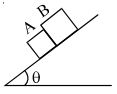
- 9The two blocks $A$ and $B$ of equal mass are initially in contact when released from rest on the inclined plane. The coefficients of friction between the inclined plane $A$ and $B$ are $\mu_1$ and $\mu_2$ respectively.View Solution
- 10Two particles of equal masses are revolving in circular paths of radii ${r_1}$ and ${r_2}$ respectively with the same speed. The ratio of their centripetal forces isView Solution