A car sometimes overturns while taking a turn. When it overturns, it is
Easy
Download our app for free and get started
(a)Because the reaction on inner wheel decreases and becomes zero. So it leaves the ground first.

Download our appand get started for free
Experience the future of education. Simply download our apps or reach out to us for more information. Let's shape the future of learning together!No signup needed.*
Similar Questions
- 1View SolutionThe limiting friction between two bodies in contact is independent of
- 2View SolutionThe force required to keep a body in uniform circular motion is
- 3A horizontal force of $4\,N$ is needed to keep a block of mass $0.5\, kg$ sliding on a horizontal surface with a constant speed. The coefficient of sliding friction must be :- $[g = 10\, m/s^2]$View Solution
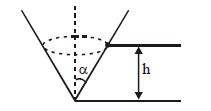
- 4A particle is describing circular motion in a horizontal plane in contact with the smooth inside surface of a fixed right circular cone with its axis vertical and vertex down. The height of the plane of motion above the vertex is $h$ and the semivertical angle of the cone is $\alpha $ . The period of revolution of the particleView Solution
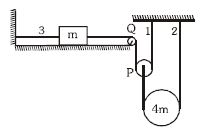
- 5Shown in the diagram is a system of two bodies, a block of mass $m$ and a disc of mass $4\ m$ , held in equilibrium. If the string $3$ is burnt, find the acceleration of the disc. Neglect the masses of the pulleys $P$ and $Q$ . The co-efficient of friction between the block and horizontal surface is $0.5$ and friction between disc and string is zero ........ $m/s^2$View Solution
- 6A block starts moving up an inclined plane of inclination $30^{\circ}$ with an initial velocity of $v_{0}$. It comes back to its initial position with velocity $\frac{v_{0}}{2} .$ The value of the coefficient of kinetic friction between the block and the inclined plane is close to $\frac{ I }{1000},$ The nearest integer to $I$ is......View Solution
- 7Two particles of equal masses are revolving in circular paths of radii ${r_1}$ and ${r_2}$ respectively with the same speed. The ratio of their centripetal forces isView Solution
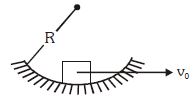
- 8A particle is projected with a speed ${v_0} = \sqrt {gR} $ . The coefficient of friction between the particle and the hemispherical plane is $\mu = 0.5$ . Then, the initial acceleration of the particle isView Solution
- 9A particle is moving along the circle $x^2 + y^2 = a^2$ in anti clock wise direction. The $x-y$ plane is a rough horizontal stationary surface. At the point $(a\, cos\theta , a\, sin\theta )$, the unit vector in the direction of friction on the particle is:View Solution
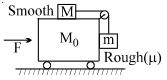
- 10Imagine $a$ situation in which the horizontal surface of block $M_0$ is smooth and its vertical surface is rough with $a$ coefficient of friction $\mu$ In above problem, the value $(s)$ of $F$ for which $M$ and $m$ are stationary with respect to $M_0 mg$View Solution