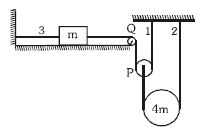
Two particles of equal masses are revolving in circular paths of radii ${r_1}$ and ${r_2}$ respectively with the same speed. The ratio of their centripetal forces is
Easy
Download our app for free and get started
(a)$F = \frac{{m{v^2}}}{r}.$ If $m$ and $v$ are constants then
$F \propto \frac{1}{r}$
$\frac{{{F_1}}}{{{F_2}}} = \left( {\frac{{{r_2}}}{{{r_1}}}} \right)$

Download our appand get started for free
Experience the future of education. Simply download our apps or reach out to us for more information. Let's shape the future of learning together!No signup needed.*
Similar Questions
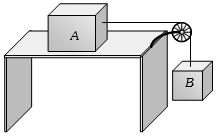
- 1The blocks $A$ and $B$ are arranged as shown in the figure. The pulley is frictionless. The mass of $A$ is $10 \,kg$. The coefficient of friction of $A$ with the horizontal surface is $0.20$. The minimum mass of $B $ to start the motion will be...... $kg$View Solution
- 2The maximum speed that can be achieved without skidding by a car on a circular unbanked road of radius $R$ and coefficient of static friction $\mu $, isView Solution
- 3A block of mass $10\, kg$ is placed on an inclined plane. When the angle of inclination is $30°$, the block just begins to slide down the plane. The force of static friction is ....... $kg\, wt$View Solution
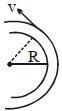
- 4A modern grand-prix racing car of mass $m$ is travelling on a flat track in a circular arc of radius $R$ with a speed $v$. If the coefficient of static friction between the tyres and the track is $\mu_{s},$ then the magnitude of negative lift $F_{L}$ acting downwards on the car isView Solution
(Assume forces on the four tyres are identical and $g =$ acceleration due to gravity)
- 5Starting from rest a body slides down a $45^o$ inclined plane in twice the time it takes to slide down the same distance in the absence of friction. The co-efficient of friction between the body and the inclined plane isView Solution
- 6A block is kept on an inclined plane of inclination $\theta$ of length l. The velocity of particle at the bottom of inclined is (the coefficient of friction is $\mu$)View Solution
- 7A block of mass $M$ rests on a rough horizontal table. A steadily increasing horizontal force is applied such that the block starts to slide on the table without toppling. The force is continued even after sliding has started. Assume the coefficients of static and kinetic friction between the table and the block to be equal. The correct representation of the variation of the frictional force $f$, exerted by the table on the block with time $t$ is given byView Solution
- 8The retarding acceleration of $7.35\, ms^{-2}$ due to frictional force stops the car of mass $400\, kg$ travelling on a road. The coefficient of friction between the tyre of the car and the road isView Solution
- 9A block rests on a rough inclined plane making an angle of $30^o$ with the horizontal. The coefficient of static friction between the block and the plane is $0.8.$ If the frictional force on the block is $10\, N$, the mass of the block (in $kg$) is : (taken $g = 10 \,m/s^2)$View Solution
- 10Shown in the diagram is a system of two bodies, a block of mass $m$ and a disc of mass $4\ m$ , held in equilibrium. If the string $3$ is burnt, find the acceleration of the disc. Neglect the masses of the pulleys $P$ and $Q$ . The co-efficient of friction between the block and horizontal surface is $0.5$ and friction between disc and string is zero ........ $m/s^2$View Solution