A car travels north with a uniform velocity. It goes over a piece of mud which sticks to the tyre. The particles of the mud, as it leaves the ground are thrown
Easy
Download our app for free and get started
(d)The particle performing circular motion flies off tangentially.

Download our appand get started for free
Experience the future of education. Simply download our apps or reach out to us for more information. Let's shape the future of learning together!No signup needed.*
Similar Questions
- 1A body $B$ lies on a smooth horizontal table and another body $A$ is placed on $B$. The coefficient of friction between $A$ and $B$ is $\mu $. What acceleration given to $B$ will cause slipping to occur between $A$ and $B$View Solution
- 2View SolutionA car is moving with uniform velocity on a rough horizontal road. Therefore, according to Newton's first law of motion
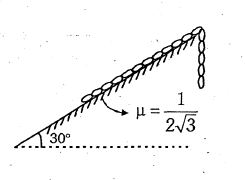
- 3A uniform chain is at rest partially on the incline and partially hanging vertically. Coefficient of friction between chain and incline is $\mu = \frac{1}{{2\sqrt 3 }}$. The ratio of $\frac{{{L_{\max }}}}{{{L_{\min }}}}$ is $(L_{max} =$ maximum length of chain kept on inclined so that chain remains at rest, $L_{min} =$ minimum length of chain kept on incline so that chain remains at rest)View Solution
- 4Radius of the curved road on national highway is $R$. Width of the road is $b$. The outer edge of the road is raised by $h$ with respect to inner edge so that a car with velocity $v$ can pass safe over it. The value of $h$ isView Solution
- 5On the horizontal surface of a truck a block of mass $1 \;kg$ is placed $(\mu=0.6)$ and truck is moving with acceleration $5\; m / sec ^2$ then the frictional force on the block will beView Solution
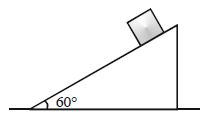
- 6A block slides down an inclined plane with an acceleration $g/2$ as shown in fig. Then coefficient of kinetic friction isView Solution
- 7A ball of mass $0.25\, kg$ attached to the end of a string of length $1.96 \,m$ is moving in a horizontal circle. The string will break if the tension is more than $25 \,N$. .......... $m/s$ is the maximum speed with which the ball can be movedView Solution
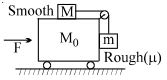
- 8Imagine $a$ situation in which the horizontal surface of block $M_0$ is smooth and its vertical surface is rough with $a$ coefficient of friction $\mu$ In above problem, choose the correct value $(s)$ of F which the blocks $M$ and $m$ remain stationary with respect to $M_0$View Solution
- 9A small object placed on a rotating horizontal turn table just slips when it is placed at a distance $4\, cm$ from the axis of rotation. If the angular velocity of the turn-table is doubled, the object slips when its distance from the axis of rotation isView Solution
- 10View SolutionA car sometimes overturns while taking a turn. When it overturns, it is