A Carnot engine absorbs an amount $Q$ of heat from a reservoir at an abosolute temperature $T$ and rejects heat to a sink at a temperature of $T/3.$ The amount of heat rejected is
Medium
Download our app for free and get started
(b) $\because \;\eta = 1 - \frac{{{T_2}}}{{{T_1}}} = \frac{W}{{{Q_1}}}$ ${T_2} = 300\,K$
where ${Q_1} = $ heat absorbed, ${Q_2} = $ heat rejected
==> $1 - \frac{{T/3}}{T} = \frac{W}{{{Q_1}}}$ ==> $\frac{2}{3} = \frac{W}{{{Q_1}}} = \frac{{{Q_1} - {Q_2}}}{{{Q_1}}}$
==> $\frac{2}{3} = 1 - \frac{{{Q_2}}}{{{Q_1}}}$ ==> $\frac{{{Q_2}}}{{{Q_1}}} = \frac{1}{3}$ ==> ${Q_2} = \frac{{{Q_1}}}{3} = \frac{Q}{3}$
where ${Q_1} = $ heat absorbed, ${Q_2} = $ heat rejected
==> $1 - \frac{{T/3}}{T} = \frac{W}{{{Q_1}}}$ ==> $\frac{2}{3} = \frac{W}{{{Q_1}}} = \frac{{{Q_1} - {Q_2}}}{{{Q_1}}}$
==> $\frac{2}{3} = 1 - \frac{{{Q_2}}}{{{Q_1}}}$ ==> $\frac{{{Q_2}}}{{{Q_1}}} = \frac{1}{3}$ ==> ${Q_2} = \frac{{{Q_1}}}{3} = \frac{Q}{3}$

Download our appand get started for free
Experience the future of education. Simply download our apps or reach out to us for more information. Let's shape the future of learning together!No signup needed.*
Similar Questions
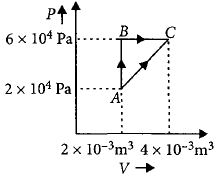
- 1Figure below shows two paths that may be taken by a gas to go from a state $A$ to a state $C.$ In process $AB,$ $400 \,J$ of heat is added to the system and in process $BC,$ $100\, J$ of heat is added to the system. The heat absorbed by the system in the process $AC$ will be ...... $J$View Solution
- 2View SolutionA gas is compressed adiabatically till its temperature is doubled. The ratio of its final volume to initial volume will be
- 3Two Carnot engines $A$ and $B$ are operated in series. The first one, $A,$ receives heat at $T_1(= 600\,K)$ and rejects to a reservoir at temperature $T_2.$ The second engine $B$ receives heat rejected by the first engine and, in turns, rejects to a heat reservoir at $T_3 (=400\,K).$ Calculate the temperature $T_2$ if the work outputs of the two engines are equal ..... $K$View Solution
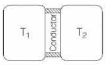
- 4A thin piece of thermal conductor of constant thermal conductivity insulated on the lateral sides connects two reservoirs which are maintained at temperatures $T_{1}$ and $T_{2}$ as shown in the figure alongside. Assuming that the system is in steady state, which of the following plots best represents the dependence of the rate of change of entropy on the ratio of $T_{1} / T_{2}$ ?View Solution
- 5The volume of air increases by $5\%$ in its adiabatic expansion. The percentage decrease in its pressure will be ...... $\%$View Solution
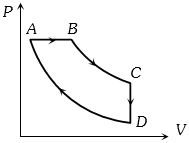
- 6A cyclic process $ABCD$ is shown in the figure $P-V$ diagram. Which of the following curves represent the same processView Solution
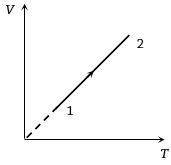
- 7Volume versus temperature graph of two moles of helium gas is as shown in figure. The ratio of heat absorbed and the work done by the gas in process $1-2$ isView Solution
- 8View SolutionIn thermodynamic processes which of the following statements is not true?
- 9An engine runs between a reservoir at temperature $200 \,K$ and a hot body which is initially at temperature of $600 \,K$. If the hot body cools down to a temperature of $400 \,K$ in the process, then the maximum amount of work that the engine can do (while working in a cycle) is (the heat capacity of the hot body is $1 \,J / K )$View Solution
- 10Consider a carnot's cycle operating between $T_1 = 500\,K$ and $T_2 = 300\,K$ producing $1\,kJ$ of mechanical work per cycle. Find the heat transferred to the engine by the reservoirs .... $J$View Solution