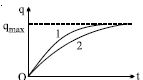
The charge across the capacitor in two different $RC$ circuits $1$ and $2$ are plotted as shown in figure. Identify the correct statement$(s)$ related to the $R_1, R_2, C_1 $ and $C_2$ of the two $RC$ circuits.
Medium
Download our app for free and get started
$I=\frac{V}{R} e^{-t / R C}$
since $\tau_{2}>\tau_{1}=R_{2} C_{2}>R_{1} C_{1}=\frac{R_{1}}{R_{2}}<\frac{C_{2}}{C_{1}}$

Download our appand get started for free
Experience the future of education. Simply download our apps or reach out to us for more information. Let's shape the future of learning together!No signup needed.*
Similar Questions
- 1An $\alpha$ particle and a proton are accelerated from rest through the same potential difference. The ratio of linear momenta acquired by above two particals will be.View Solution
- 2After the switch shown in figure $A$ is closed, there is current $i$ through resistance $R$. Figure $B$ indicates current variation curves $a, b, c$ and $d$ for four sets of values of $R$ and capacitance $C$:View Solution
$(i)$ $R_0$ and $C_0$, $(ii)$ $2R_0$ and $C_0$,
$(iii)$ $R_0$ and $2C_0$, $(iv)$ $2R_0$ and $2C_0$.
Which set goes with which curve?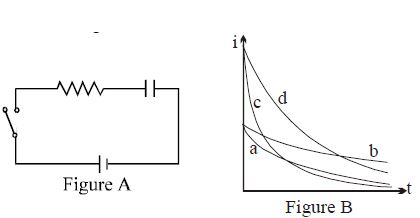
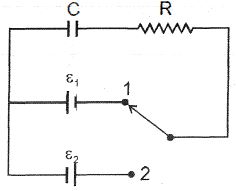
- 3Intially, switch $S$ is connected to position $1$ for a long time shown in figure. The net amount of heat generated in the circuit after it is shifted to position $2$ isView Solution
- 4Condenser $A$ has a capacity of $15\,\mu F$ when it is filled with a medium of dielectric constant $15$. Another condenser $B$ has a capacity of $1\,\mu F$ with air between the plates. Both are charged separately by a battery of $100\;V$. After charging, both are connected in parallel without the battery and the dielectric medium being removed. The common potential now is.....$V$View Solution
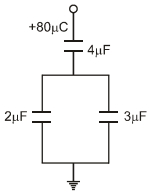
- 5In the given circuit, a charge of $+80 \ \mu C$ is given to the upper plate of the $4 \ \mu F$ capacitor. Then in the steady state, the charge on the upper plate of the $3 \ \mu F$ capacitor is :View Solution
- 6View SolutionCan a metal be used as a medium for dielectric
- 7The electrostatic force between the metal plates of an isolated parallel plate capacitor $C$ having a charge $Q$ and area $A,$ isView Solution
- 8There is an electric field $E$ in $X$-direction. If the work done on moving a charge $0.2\,C$ through a distance of $2\,m$ along a line making an angle $60^\circ $ with the $X$-axis is $4.0\;J$, what is the value of $E$........ $N/C$View Solution
- 9A negatively charged plate has charge density of $2 \times {10^{ - 6}}\,C/{m^2}$. The initial distance of an electron which is moving toward plate, cannot strike the plate, if it is having energy of $200\,eV$View Solution
- 10View SolutionFour very large metal plates are given the charges as shown in figure. The middle two are then connected through a wire. Find the charge that will flow through the wire