A cell of internal resistance $1.5\,\Omega $ and of $e.m.f.$ $1.5\, volt$ balances $500\, cm$ on a potentiometer wire. If a wire of $15\,\Omega $ is connected between the balance point and the cell, then the balance point will shift
Easy


Download our appand get started for free
Experience the future of education. Simply download our apps or reach out to us for more information. Let's shape the future of learning together!No signup needed.*
Similar Questions
- 1A $1\,m$ long copper wire carries a current of $1\,A$. If the cross section of the wire is $2.0\,mm ^{2}$ and the resistivity of copper is $1.7 \times 10^{-8}\,\Omega\,m$. the force experienced by moving electron in the wire is $\times 10^{-23}\,N$. (charge on electron $=1.6 \times 10^{-19}\,C$ )View Solution
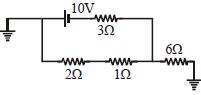
- 2Find current in $6\,\Omega $ resistanceView Solution
- 3In a potentiometer circuit a cell of $EMF$ $1.5\, {V}$ gives balance point at $36\, {cm}$ length of wire. If another cell of $EMF$ $2.5\, {V}$ replaces the first cell, then at what length of the wire, the balance point occurs ? (in $cm$)View Solution
- 4View SolutionWhich of the following statement is false
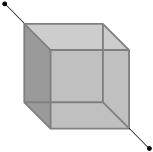
- 5Twelve wires of equal length and same cross-section are connected in the form of a cube. If the resistance of each of the wires is $R$, then the effective resistance between the two diagonal ends would beView Solution
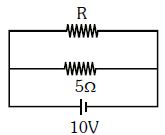
- 6The power dissipated in the circuit shown in the figure is $30\, Watts$. The value of $R$ is ............. $\Omega$View Solution
- 7$A$ uniform copper wire carries a current $i$ amperes and has $p$ carriers per meter$^3$. The length of the wire is $\lambda$ meters and its cross-section area is $s$ meter $^2$. If the charge on a carrier is $q$ coulombs, the drift velocity in $ms^{-1}$ is given byView Solution
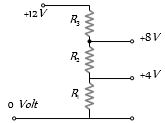
- 8A potential divider is used to give outputs of $4\, V$ and $8\, V$ from a $12\, V$ source. Which combination of resistances, $(R_1, R_2, R_3)$ gives the correct voltages ? $R_1 : R_2 : R_3$View Solution
- 9The drift velocity of electrons for a conductor connected in an electrical circuit is $V _{ d }$. The conductor in now replaced by another conductor with same material and same length but double the area of cross section. The applied voltage remains same. The new drift velocity of electrons will beView Solution
- 10View SolutionWhen a potential difference is applied across the ends of a linear metallic conductor