A charge of $10 \,\mu C$ is placed at the origin of $x-y$ coordinate system. The potential difference between two points $(0, a)$ and $(a, 0)$ in volt will be
Easy
Download our app for free and get started
(d)
$V_A=\frac{k q}{a}$
$V_B=\frac{k q}{a}$
$\Delta V=V_A-V_B=0$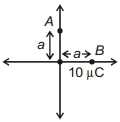

Download our appand get started for free
Experience the future of education. Simply download our apps or reach out to us for more information. Let's shape the future of learning together!No signup needed.*
Similar Questions
- 1A parallel plate capacitor of capacitance $C$ is connected to a battery and is charged to a potential difference $V$. Another capacitor of capacitance $2C$ is similarly charged to a potential difference $2V$. The charging battery is now disconnected and the capacitors are connect in parallel to each other in such a way that the positive terminal of one is connected to the negative terminal of the other. The final energy of the configuration isView Solution
- 2Two equal charges $q$ of opposite sign separated by a distance $2a$ constitute an electric dipole of dipole moment $p$. If $P$ is a point at a distance $r$ from the centre of the dipole and the line joining the centre of the dipole to this point makes an angle $\theta $ with the axis of the dipole, then the potential at $P$ is given by $(r > > 2a)$ (Where $p = 2qa$)View Solution
- 3The electric potential in a region is represented as $V = 2x + 3y -z$ ; then the expression of electric field strength isView Solution
- 4Three capacitors of $2\,\mu F,\,3\,\mu F$ and $6\,\mu F$ are joined in series and the combination is charged by means of a $24\, volt$ battery. The potential difference between the plates of the $6\,\mu F$ capacitor is.......$volt$View Solution
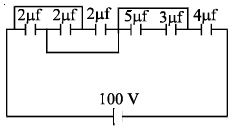
- 5In the circuit shown in figure charge stored in the capacitor of capacity $5\ \mu f$ is......$ \mu C$View Solution
- 6View SolutionA non uniformly shaped conductor is charged then at it's sharpest point
- 7Three infinitely long linear charges of charge density $\lambda $ , $\lambda $ and $-2\lambda $ are placed in space. A point in space is specified by its perpendicular distance $r_1 , r_2 $ and $ r_3$ respectively from the linear charges. For the points which are equipotentialView Solution
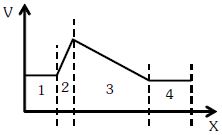
- 8In which region magnitude of $x$ -component of electric field is maximum, if potential $(V)$ versus distance $(X)$, graph is as shown?View Solution
- 9Two charged capacitors have their outer plates fixed and inner plates connected by a spring of force constant ' $k$ '. The charge on each capacitor is q. Find the extension in the spring at equilibriumView Solution
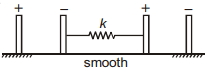
- 10A parallel plate capacitor of capacitance $C$ is connected to a battery and is charged to a potential difference $V$. Another capacitor of capacitance $2C$ is connected to another battery and is charged to potential difference $2V$. The charging batteries are now disconnected and the capacitors are connected in parallel to each other in such a way that the positive terminal of one is connected to the negative terminal of the other. The final energy of the configuration isView Solution