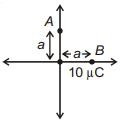
A charge of $10 \,\mu C$ is placed at the origin of $x-y$ coordinate system. The potential difference between two points $(0, a)$ and $(a, 0)$ in volt will be
Easy


Download our appand get started for free
Experience the future of education. Simply download our apps or reach out to us for more information. Let's shape the future of learning together!No signup needed.*
Similar Questions
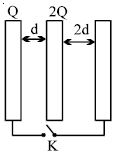
- 1Three large plates are arranged as shown. How much charge will flow through the key $k $ if it is closed?View Solution
- 2Electric charges of $+10\,\mu\, C, +5\,\mu\, C, -3\,\mu\, C$ and $+8\,\mu\, C$ are placed at the corners of a square of side$\sqrt 2\,m$ . The potential at the centre of the square isView Solution
- 3A parallel plate capacitor with plate separation $5$ $\mathrm{mm}$ is charged up by a battery. It is found that on introducing a dielectric sheet of thickness $2 \mathrm{~mm}$, while keeping the battery connections intact, the capacitor draws $25 \%$ more charge from the battery than before. The dielectric constant of the sheet is_____.View Solution
- 4If three capacitors each of capacity $1\,\mu F$ are connected in such a way that the resultant capacity is $1.5\,\mu F$, thenView Solution
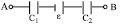
- 5A circuit shown in the figure consists of a battery of $emf$ $10$ $V$ and two capacitance $C_1$ and $C_2 $ of capacitances $1.0$ $ \mu F$ and $2.0$ $\mu F$ respectively. The potential difference $V_A - V_B$ is $5\,V$View Solution
- 6$S_1$ and $S_2$ are two equipotential surfaces on which the potentials are not equal. Which of the statement is incorrect ?View Solution
- 7The magnitude of electric field $E$ in the annular region of a charged cylindrical capacitorView Solution
- 8The displacement of a charge $Q$ in the electric field $E = {e_1}\hat i + {e_2}\hat j + {e_3}\hat k$ is $\hat r = a\hat i + b\hat j$. The work done isView Solution
- 9A capacitor has air as dielectric medium and two conducting plates of area $12 \mathrm{~cm}^2$ and they are $0.6 \mathrm{~cm}$ apart. When a slab of dielectric having area $12 \mathrm{~cm}^2$ and $0.6 \mathrm{~cm}$ thickness is inserted between the plates, one of the conducting plates has to be moved by $0.2 \mathrm{~cm}$ to keep the capacitance same as in previous case. The dielectric constant of the slab is : (Given $\left.\epsilon_0=8.834 \times 10^{-12} \mathrm{~F} / \mathrm{m}\right)$View Solution
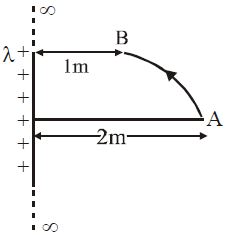
- 10Figure shows a positively charged infinite wire. $A$ particle of charge $2C$ moves from point $A$ to $B$ with constant speed. (Given linear charge density on wire is $\lambda = 4 \pi \varepsilon_0$)View Solution