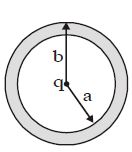
$125$ identical drops each charged to the same potential of $50\;volts$ are combined to form a single drop. The potential of the new drop will be......$V$
Medium
Download our app for free and get started
(d) $V = n^{2/3} v ==> V = (125)^{2/3} \times 50 = 1250\, V$

Download our appand get started for free
Experience the future of education. Simply download our apps or reach out to us for more information. Let's shape the future of learning together!No signup needed.*
Similar Questions
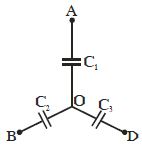
- 1Three uncharged capacitors of capacitance $C_1$, $C_2$ and $C_3$ are connected as shown in figure to one another and to points $A$, $B$ and $D$ at potentials $V_A$, $V_B$ and $V_D$. Then the potential at $O$ will beView Solution
- 2A parallel plate capacitor with area $200\,cm^2$ and separation between the plates $1.5\,cm$, is connected across a battery of $emf$ $V$. If the force of attraction between the plates is $25\times10^{-6}\,N$, the value of $V$ is approximately........$V$ $\left( {{\varepsilon _0} = 8.85 \times {{10}^{ - 12}}\,\frac{{{C^2}}}{{N{m^2}}}} \right)$View Solution
- 3In a uniform electric field, a cube of side $1\ cm$ is placed. The total energy stored in the cube is $8.85\mu J$ . The electric field is parallel to four of the faces of the cube. The electric flux through any one of the remaining two faces is.View Solution
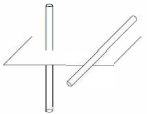
- 4Two mutually perpendicular infinitely long straight conductors carrying uniformly distributed charges of linear densities $\lambda_{1}$ and $\lambda_{2}$ are positioned at a distance $r$ from each other. Force between the conductors depends on $r$ asView Solution
- 5A capacitor of capacitance $C$ is charged to a potential difference $V$ from a cell and then disconnected from it. A charge $+Q$ is now given to its positive plate. The potential difference across the capacitor is now $Q$View Solution
if $V < CV$
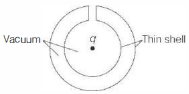
- 6A positive charge $q$ is placed at the centre of a neutral hollow cylindrical conducting shell with its cross-section as shown in the figure below. Which one of the following figures correctly indicates the induced charge distribution on the conductor? (Ignore edge effects)View Solution
- 7A uniform electric field pointing in positive $x$-direction exists in a region. Let $A$ be the origin, $B$ be the point on the $x$-axis at $x = + 1$ $cm$ and $C$ be the point on the $y$-axis at $y = + 1\,cm$. Then the potentials at the points $A$, $B$ and $C$ satisfyView Solution
- 8In the figure shown, the effective capacitance between the points $A$ and $B$, if each has capacitance $C$, isView Solution
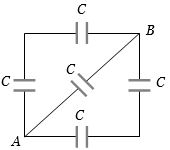
- 9Two thin conducting shells of radii $R$ and $3R$ are shown in the figure. The outer shell carries a charge $+ Q$ and the inner shell is neutral. The inner shell is earthed with the help of a switch $S$.View Solution
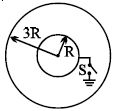
- 10In the figure shown the electric potential energy of the system is: ( $q$ is at the centre of the conducting neutral spherical shell of inner radius $a$ and outer radius $b$ )View Solution