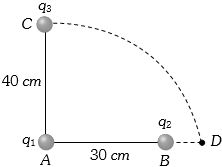
Two charges ${q_1}$ and ${q_2}$ are placed $30\,\,cm$ apart, shown in the figure. A third charge ${q_3}$ is moved along the arc of a circle of radius $40\,cm$ from $C$ to $D$. The change in the potential energy of the system is $\frac{{{q_3}}}{{4\pi {\varepsilon _0}}}k$, where $k$ is
AIPMT 2005, Diffcult
Download our app for free and get started
(a) Change in potential energy ($\Delta$$U$)$ = Uf -Ui$
$==>$ $\Delta U = \frac{1}{{4\pi {\varepsilon _0}}}\left[ {\left( {\frac{{{q_1}{q_3}}}{{0.4}} + \frac{{{q_2}{q_3}}}{{0.1}}} \right) - \left( {\frac{{{q_1}{q_3}}}{{0.4}} + \frac{{{q_2}{q_3}}}{{0.5}}} \right)} \right]$
$==>$ $\Delta U = \frac{1}{{4\pi {\varepsilon _0}}}[8{q_2}{q_3}] = \frac{{{q_3}}}{{4\pi {\varepsilon _0}}}(8{q_2})$
$k = 8q_2$
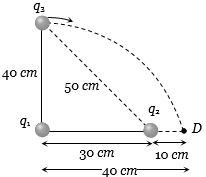
$==>$ $\Delta U = \frac{1}{{4\pi {\varepsilon _0}}}\left[ {\left( {\frac{{{q_1}{q_3}}}{{0.4}} + \frac{{{q_2}{q_3}}}{{0.1}}} \right) - \left( {\frac{{{q_1}{q_3}}}{{0.4}} + \frac{{{q_2}{q_3}}}{{0.5}}} \right)} \right]$
$==>$ $\Delta U = \frac{1}{{4\pi {\varepsilon _0}}}[8{q_2}{q_3}] = \frac{{{q_3}}}{{4\pi {\varepsilon _0}}}(8{q_2})$
$k = 8q_2$

Download our appand get started for free
Experience the future of education. Simply download our apps or reach out to us for more information. Let's shape the future of learning together!No signup needed.*
Similar Questions
- 1A capacitor of capacitance $10\, mF$ is connected to a battery of emf $2\,V.$ It is found that it takes $50\, ms$ for the charge on the capacitor to become $12.6 \,mC.$ Then the resistance of the circuit is :.......$\, k \Omega$ (Take $1/e = 0.37$):-View Solution
- 2A capacitor having capacitance $C$ is charged to a voltage $V$. It is then removed and connected in parallel with another identical capacitor which is uncharged. The new charge on each capacitor is nowView Solution
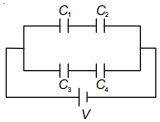
- 3Find the charge on capacitor $C_3$View Solution
Given, that $C_1=C_2=C$ and $C_3=C_4=3 C$.
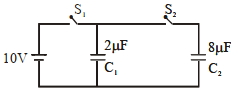
- 4A $2\, \mu F$ capacitor $C _{1}$ is first charged to a potential difference of $10\, V$ using a battery.Then the battery is removed and the capacitor is connected to an uncharged capacitor $C _{2}$ of $8\, \mu F$. The charge in $C _{2}$ on equilibrium condition is $\ldots\,\mu C$. (Round off to the Nearest Integer)View Solution
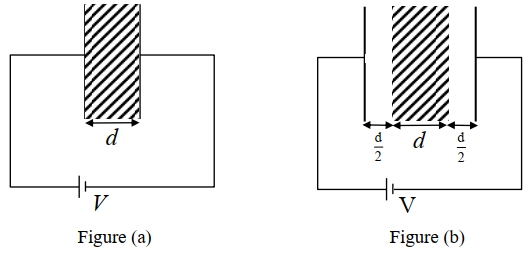
- 5A medium having dielectric constant $K>1$ fills the space between the plates of a parallel plate capacitor. The plates have large area, and the distance between them is $d$. The capacitor is connected to a battery of voltage $V$. as shown in Figure ($a$). Now, both the plates are moved by a distance of $\frac{d}{2}$ from their original positions, as shown in Figure ($b$).View Solution
In the process of going from the configuration depicted in Figure ($a$) to that in Figure ($b$), which of the following statement($s$) is(are) correct?
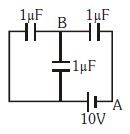
- 6If potential of $A$ is $10\,V$, then potential of $B$ isView Solution
- 7A $5.0\, \mu F$ capacitor is charged to a potential difference $800\, V$ and discharged through a conductor. The energy(in $J$) given to a conductor during the discharge isView Solution
- 8Two charged spheres of radii $10\, cm$ and $15\, cm$ are connected by a thin wire. No current will flow, if they haveView Solution
- 9Charge $q_{2}$ is at the centre of a circular path with radius $r$. Work done in carrying charge $q_{1}$, once around this equipotential path, would beView Solution
- 10The resultant capacitance between $A$ and $B$ in the fig. is......$\mu F$View Solution