A charged particle moves with velocity $v$ in a uniform magnetic field $\overrightarrow B $. The magnetic force experienced by the particle is
Easy
Download our app for free and get started
$\overrightarrow F = q(\overrightarrow v \times \overrightarrow B )$; if $\overrightarrow v ||\,\overrightarrow B $ then $\overrightarrow F = 0$

Download our appand get started for free
Experience the future of education. Simply download our apps or reach out to us for more information. Let's shape the future of learning together!No signup needed.*
Similar Questions
- 1A charge particle moving in magnetic field $B$, has the components of velocity along $B$ as well as perpendicular to $B$. The path of the charge particle will beView Solution
- 2Choose the correct sketch of the magnetic field lines of a circular current loop shown by the dot $ \odot $ and the cross $\otimes .$View Solution
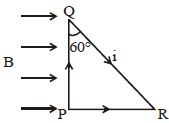
- 3For the circuit shown in figure, the direction and magnitude of the force on $PQR$ is :-View Solution
- 4A cylindrical conductor of radius $R$ is carrying a constant current. The plot of the magnitude of the magnetic field, $B$ with the distance $d$, from the centre of the conductor, is correctly represented by the figure$.....$View Solution
- 5Two concentric coils each of radius equal to $2\pi \,{\rm{ }}cm$ are placed at right angles to each other. $3$ $ampere$ and $4$ $ampere$ are the currents flowing in each coil respectively. The magnetic induction in $Weber/{m^2}$ at the centre of the coils will be $({\mu _0} = 4\pi \times {10^{ - 7}}\,Wb/A.m)$View Solution
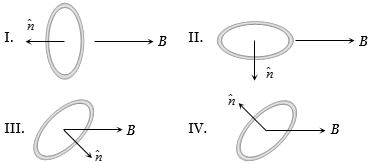
- 6A current carrying loop is placed in a uniform magnetic field in four different orientations, $I$, $II$, $III$ & $IV$ arrange them in the decreasing order of potential EnergyView Solution
- 7View SolutionAn electron is travelling in east direction and a magnetic field is applied in upward direction then electron will deflect in
- 8View SolutionWhich of the field patterns given below is valid for electric field as well as for magnetic field?
- 9View SolutionTwo parallel wires are carrying electric currents of equal magnitude and in the same direction. They exert
- 10View SolutionMaximum kinetic energy of the positive ion in the cyclotron is