Question
A circular disc of mass $10kg$ is suspended by a wire attached to its centre. The wire is twisted by rotating the disc and released. The period of torsional oscillations is found to be $1.5s$. The radius of the disc is $15cm$. Determine the torsional spring constant of the wire. (Torsional spring constant $\alpha$ is defined by the relation $\text{J}=-\alpha\theta,$ where J is the restoring couple and $\theta$ the angle of twist).
Answer

Mass of the circular disc, m = 10kg Radius of the disc, r = 15cm = 0.15m The torsional oscillations of the disc has a time period, T = 1.5s The moment of inertia of the disc is:$\text{l}=\frac{1}{2}\text{mr}^2$
$=\frac{1}{2}\times(10)\times(0.15)^2$
$= 0.1125kg m^2$ Time period, $\text{T}=2\pi\sqrt{\frac{\text{l}}{\alpha}}$$\alpha$ is the torsional constant.
$\alpha=\frac{4\pi^2\text{l}}{\text{T}^2}$
$=\frac{4\times(\pi)^2\times0.1125}{(1.5)^2}$
= 1.972Nm/rad Hence, the torsional spring constant of the wire is $1.972Nm\ rad^{-1}$.

Need a full question paper?

Generate a complete, print-ready paper with questions like this in minutes — across 16+ boards, with answer keys.

Start Generating Free

Similar questions

A ball is dropped from a building of height 45m. Simultaneously another ball is thrown up with a speed 40m/s. Calculate the relative speed of the balls as a function of time.
Mathematically describe the motion of a particle along a plane (or along a two-dimensional plane).
The force of buoyancy exerted by the atmosphere on a balloon is B in the upward direction and remains constant. The force of air resistance on the balloon acts opposite to the direction of velocity and is proportional to it. The balloon carries a mass M and is found to fall down near the earth's surface with a constant velocity v. How much mass should be removed from the balloon so that it may rise with a constant velocity v?
Two stationary particles of masses $M_1$ and $M_2$ are a distance d' apart. A third particle lying on the line joining the particles, experiences no resultant gravitational force. What is the distance of this particle from $M_1$?
A capacitor of capacitance $5.00\mu\text{F}$ is charged to $24.0V$ and another capacitor of capacitance $6.0\mu\text{F}$ is charged to $12.0V$:
  1. Find the energy stored in each capacitor.
  2. The positive plate of the first capacitor is now connected to the negative plate of the second and vice versa. Find the new charges on the capacitors.
  3. Find the loss of electrostatic energy during the process.
  4. Where does this energy go?
  1. State Pascal's law. Explain the working of hydraulic lift.
  2. Find out the height of atmosphere if the density of the atmosphere at sec level is $1.29km/ m^3$. Assume that it does not change with altitude.
A concave mirror forms an image of $20cm$ high object on a screen placed $5.0m$ away from the mirror. The height of the image is $50cm$. Find the focal length of the mirror and the distance between the mirror and the object.
What are stationary waves? How are they formed in strings? Draw the various modes of vibration in them.
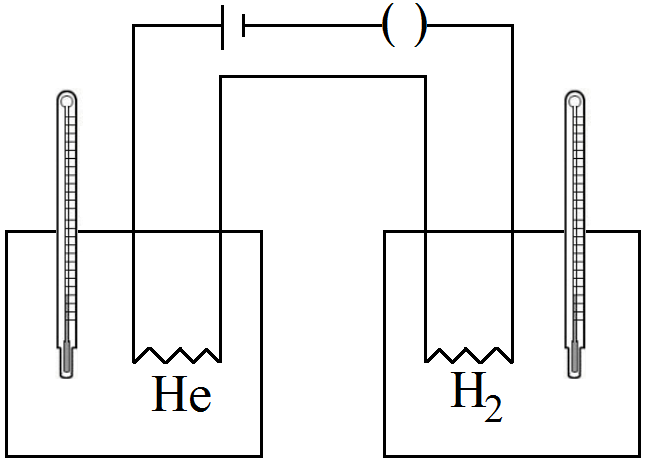
The figure shows two vessels with adiabatic walls, one containing 0.1g of helium $\big(\gamma=1.67,\text{M}=4\text{g-mol}^{-1}\big)$ and the other containing some amount of hydrogen $\big(\gamma=1.4,\text{M}=2\text{g-mol}^{-1}\big).$ Initially, the temperatures of the two gases are equal. The gases are electrically heated for some time during which equal amounts of heat are given to the two gases. It is found that the temperatures rise through the same amount in the two vessels. Calculate the mass of hydrogen.
Torques of equal magnitude are applied to a hollow cylinder and a solid sphere, both having the same mass and radius. The cylinder is free to rotate about its standard axis of symmetry, and the sphere is free to rotate about an axis passing through its centre. Which of the two will acquire a greater angular speed after a given time.