Torques of equal magnitude are applied to a hollow cylinder and a solid sphere, both having the same mass and radius. The cylinder is free to rotate about its standard axis of symmetry, and the sphere is free to rotate about an axis passing through its centre. Which of the two will acquire a greater angular speed after a given time.
Exercise
Download our app for free and get started
Let $m$ and $r$ be the respective masses of the hollow cylinder and the solid sphere. The moment of inertia of the hollow cylinder about its standard axis, $\mathrm{I}_{\mathrm{I}}=\mathrm{mr}^2$ The moment of inertia of the solid sphere about an axis passing through its centre, $\mathrm{I}_{\|}=2 / 5 \mathrm{mr}^2$ We have the relation: $\mathrm{T}=\mathrm{I} \alpha$ Where, $\alpha=$ Angular acceleration $\mathrm{T}=$ Torque $\mathrm{I}=$ Moment of inertia For the hollow cylinder, $\mathrm{T}_{\mathrm{I}}=\mathrm{I}_{\mathrm{I}} \alpha_{\mathrm{I}}$ For the solid sphere, $\mathrm{T}_{\mathrm{II}}=\mathrm{I}_{\mathrm{II}} \alpha_{\mathrm{II}}$ As an equal torque is applied to both the bodies, $\mathrm{T}_I=\mathrm{T}_2$
$ \therefore \frac{\alpha_{\mathrm{II}}}{\alpha_{\mathrm{I}}}=\frac{\mathrm{I}_{\mathrm{I}}}{\mathrm{I}_{\mathrm{II}}}=\frac{\mathrm{mr}^2}{\frac{2}{3 \mathrm{sm}{ }^2}}=\frac{2}{5} \alpha_{\mathrm{II}}>\alpha_{\mathrm{I}} \ldots$ (i) Now, using the relation, $\omega=\omega_0+\alpha \mathrm{t}$
Where, $\omega_0=$ Initial angular velocity $t=$ Time of rotation $\omega=$ Final angular velocity For equal $\omega_0$ and $t$, we have, $\omega \propto \alpha .$. (ii) From equations (i) and (ii), we can write, $\omega_{\text {II }}>\omega_I$ Hence, the angular velocity of the solid sphere will be greater than that of the hollow cylinder.
$ \therefore \frac{\alpha_{\mathrm{II}}}{\alpha_{\mathrm{I}}}=\frac{\mathrm{I}_{\mathrm{I}}}{\mathrm{I}_{\mathrm{II}}}=\frac{\mathrm{mr}^2}{\frac{2}{3 \mathrm{sm}{ }^2}}=\frac{2}{5} \alpha_{\mathrm{II}}>\alpha_{\mathrm{I}} \ldots$ (i) Now, using the relation, $\omega=\omega_0+\alpha \mathrm{t}$
Where, $\omega_0=$ Initial angular velocity $t=$ Time of rotation $\omega=$ Final angular velocity For equal $\omega_0$ and $t$, we have, $\omega \propto \alpha .$. (ii) From equations (i) and (ii), we can write, $\omega_{\text {II }}>\omega_I$ Hence, the angular velocity of the solid sphere will be greater than that of the hollow cylinder.

Download our appand get started for free
Experience the future of education. Simply download our apps or reach out to us for more information. Let's shape the future of learning together!No signup needed.*
Similar Questions
- 1A car weighs $1800kg$. The distance between its front and back axles is $1.8m$. Its centre of gravity is $1.05m$ behind the front axle. Determine the force exerted by the level ground on each front wheel and each back wheel.View Solution
- 2View SolutionA threaded rod with 12turns/ cm and diameter 1.18cm is mounted horizontally. A bar with a threaded hole to match the rod is screwed onto the rod. The bar spins at 216rev/ min. How long will it take for the bar to move 1.50cm along the rod?
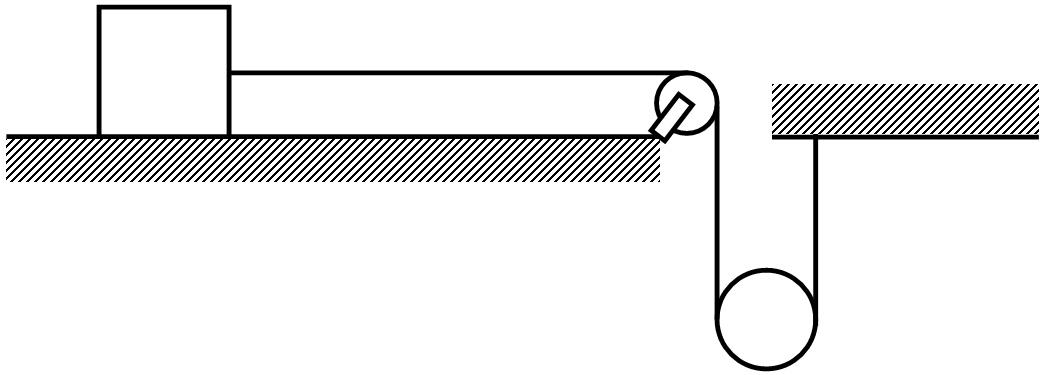
- 3The descending pulley shown in figure has a radius $20cm$ and moment of inertia $0.20kg-m^2$. The fixed pulley is light and the horizontal plane frictionless. Find the acceleration of the block if its mass is $1.0kg$.View Solution
- 4Prove the result that the velocity v of translation of a rolling body (like a ring, disc, cylinder or sphere) at the bottom of an inclined plane of a height h is given by $\text{v}^2=\frac{2\text{gh}}{\Big(\frac{1+\text{k}^2}{\text{R}^2}\Big)}$ using dynamical consideration (i.e. by consideration of forces and torques).View Solution
Note: k is the radius of gyration of the body about its symmetry axis, and R is the radius of the body. The body starts from rest at the top of the plane. - 5Separation of Motion of a system of particles into motion of the centre of mass and motion about the centre of mass: Show $\text{L}=\text{L}'+\text{R}\times\text{MV}$ where $\text{L}'=\sum\text{r}'_\text{i}\times\text{p}'_\text{i}$ is the angular momentum of the system about the centre of mass with velocities taken relative to the centre of mass. Remember $\text{r}'_\text{i}=\text{r}_\text{i}-\text{R},$ rest of the notation is the standard notation used in the chapter. Note: $\text{L}'$ and $\text{MR}\times\text{V}$ can be said to be angular momenta, respectively, about and of the centre of mass of the system of particles.View Solution
- 6Separation of Motion of a system of particles into motion of the centre of mass and motion about the centre of mass: Show $\frac{\text{dL}}{\text{dt}}=\sum\text{r}'_\text{i}\times\frac{\text{dp}'}{\text{dt}}$ Further, show that $\frac{\text{dL}'}{\text{dt}}=\tau'_\text{ext}$ where $\tau'_\text{ext}$ is the sum of all external torques acting on the system about the centre of mass. (Hint: Use the definition of centre of mass and third law of motion. Assume the internal forces between any two particles act along the line joining the particles)View Solution
- 7A disc of mass $5kg$ and radius $50cm$ rolls on the ground at the rate of $10ms^{-1}$. Calculate the K.E. of the disc. $\Big(\text{Given}:\text{I}=\frac{1}{2}\text{MR}^2\Big)$View Solution
- 8Two discs of moments of inertia $I_1$ and $I_2$ about their respective axes (normal to the disc and passing through the centre), and rotating with angular speed $\omega_1$ and $\omega_2$ are brought into contact face to face with their axes of rotation coincident.View Solution
- Does the law of conservation of angular momentum apply to the situation? why?
- Find the angular speed of the two-disc system.
- Calculate the loss in kinetic energy of the system in the process.
- Account for this loss.
- 9View Solution
- Obtain an expression for moment of inertia of uniform circular disc about an axis perpendicular to the plane of disc and passing through its centre.
- Three point masses of 1kg, 2kg and 3kg lie at (1, 2), (0, -1) and (2, -3) respectively. Calculate the co-ordinates of centre of mass of the system.
- 10Locate the centre of mass of a system of particles of mass $m_1 = 1kg, m_2 = 2kg$ and $m_3 = 3kg$, situated at the corners of an equilateral triangle of side 1.0 metre.View Solution