MCQ
$A$ closed planar wire loop of area $A$ and arbitrary shape is placed in a uniform magnetic field of magnitude $B$, with its plane perpendicular to magnetic field. The resistance of the wire loop is $R$. The loop is now turned upside down by $180^o$ so that its plane again becomes perpendicular to the magnetic field. The total charge that must have flowed through the wire ring in the process is
  • A
    $< AB/R$
  • B
    $= AB/R$
  • $= 2AB/R$
  • D
    None

Answer

Correct option: C.
$= 2AB/R$
c
induced emf $=\frac{d(f l u x)}{d t}=R \frac{d q}{d t}$

$\Rightarrow \Delta q=\frac{\Delta(f l u x)}{R}=\frac{2 B A}{R}$

Need a full question paper?

Generate a complete, print-ready paper with questions like this in minutes — across 16+ boards, with answer keys.

Start Generating Free

Similar questions

The kinetic energy of revolving electron in hydrogen of radius ' $r$ ' will be :
A wire of diameter $0.02\,meter$ contains $10^{28}$ free electrons per cubic meter. For an electrical current of $100\, A$, the drift velocity of the free electrons in the wire is nearly
Consider the points lying on a straight line joining two fixed opposite charges. Between the charges there is
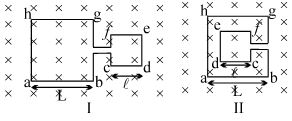
The adjoining figure shows two different arrangements in which two square wire frames are placed in a uniform constantly decreasing magnetic field $B.$ The direction of induced current in the case $I$ is
The electric potential (V) inside a uniformly charged. spherical shell depends on distance:
In a hypothetical system a particle of mass $m$ and charge $-3\,q$ is moving around a very heavy particle having cahrge $q$. Assuming Bohr’s model to be true to this system, the orbital velocity of mass $m$ when it is nearest to heavy particle is 
Consider a hydrogen-like ionized atom with atomic number $Z$ with a single electron. In the emission spectrum of this atom, the photon emitted in the $n =2$ to $n =1$ transition has energy $74.8 eV$ higher than the photon emitted in the $n =3$ to $n =2$ transition. The ionization energy of the hydrogen atom is $13.6 eV$. The value of $Z$ is. . . . . .
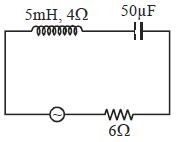
In the circuit shown below, the ac source has voltage $V = 20\, cos \,(\omega t)$ with $\omega  = 2000\,rad/sec$. The amplitude of the current will be nearest to.....$A$
$ 1 \text { Tesla = } $ $\qquad$ Gauss
In $X-$ ray tube when the accelerating voltage $V$ is halved, the difference between the wavelength of $K_{\alpha}$ line and minimum wavelength of continuous $X-$ ray spectrum