A coil is placed in $y-z$ plane making an angle of $30^{\circ}$ with $x$ -axis. The current through coil is $I,$ and number of turns are $N$. If a magnetic field of strength $'B'$ is applied in positive $x-$direction, then find the torque experienced by the coil (Radius of coil is $R$) (in $N \cdot m$)
$\left(N=100, I=1 A, R=2\, m, B=\frac{1}{\pi} T\right)$
AIIMS 2019, Medium


Download our appand get started for free
Experience the future of education. Simply download our apps or reach out to us for more information. Let's shape the future of learning together!No signup needed.*
Similar Questions
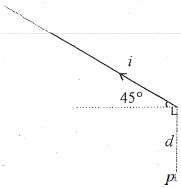
- 1Find the magnitude of magnetic field at point $p$ due to a semi - infinite wire given belowView Solution
- 2Two very long straight parallel wires, parallel to $y-$ axis,carrycurrents $4I$ and $I,$ along $+y$ directionand$-y$ direction, respectively. The wires are passes through the $x-$axis at the points $(d, 0, 0)$ and $(- d, 0, 0)$ respectively.The graph of magnetic field $z-$component as one moves along the $x-$axis from $x=- d$ to $x= +d,$ is best given byView Solution
- 3A moving coil galvanometer has $50$ turns and each turn has an area $2 \times 10^{-4} m ^2$. The magnetic field produced by the magnet inside the galvanometer is $0.02 T$. The torsional constant of the suspension wire is $10^{-4} N m rad ^{-1}$. When a current flows through the galvanometer, a full scale deflection occurs if the coil rotates by $0.2$ rad. The resistance of the coil of the galvanometer is $50 \Omega$. This galvanometer is to be converted into an ammeter capable of measuring current in the range $0-1.0 A$. For this purpose, a shunt resistance is to be added in parallel to the galvanometer. The value of this shunt resistance, in ohms, is. . . . . .View Solution
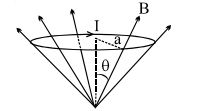
- 4A circular current loop of radius a is placed in a radial field $B$ as shown. The net force acting on the loop isView Solution
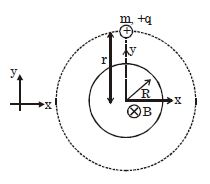
- 5Circular region of radius $R$ has uniform magnetic field $B = {B_0} + {B_0}t\left( { - \hat k} \right).\,At\,\,t\, = 0\,$ acceleration of charged particleView Solution
- 6Two mutually perpendicular conductors carrying currents $I_1$ and $I_2$ lie in one plane. Locus of the point at which the magnetic induction is zero, is aView Solution
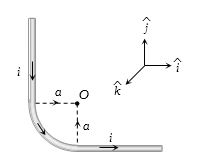
- 7The unit vectors $\hat i,\;\hat j\;{\rm{and }}\,\hat k$ are as shown below. What will be the magnetic field at $O$ in the following figureView Solution
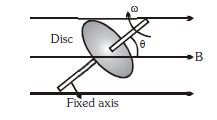
- 8A disc of radius $r$ and carrying positive charge $q$ is rotating with an angular speed $l$ in a uniform magnetic field $B$ about a fixed axis as shown in figure, such that angle made by axis of disc with magnetic field is $\theta $. Torque applied by axis on the disc isView Solution
- 9An electron moves with a constant speed $v$ along a circle of radius $r$. Its magnetic moment will be ($e$ is the electron's charge)]View Solution
- 10A charge of $2.0\,\mu C$ moves with a speed of $3.0 \times {10^6}\,m{s^{ - 1}}$ along $+ ve$ $X$ - axis $A$ magnetic field of strength $\vec B = - 0.2\,\,\hat k$ $Tesla$ exists in space. What is the magnetic force $({\overrightarrow F _m})$ on the chargeView Solution