Two friends $A$ and $B$ are waiting for another friend for tea. $A$ took the tea in a cup and mixed the cold milk and then waits. $B$ took the tea in the cup and then mixed the cold milk when the friend comes. Then the tea will be hotter in the cup of
Medium


Download our appand get started for free
Experience the future of education. Simply download our apps or reach out to us for more information. Let's shape the future of learning together!No signup needed.*
Similar Questions
- 1A body takes $T$ minutes to cool from ${62^o}C$ to ${61^o}C$ when the surrounding temperature is ${30^o}C$. The time taken by the body to cool from ${70^o}$ to $({A_1}\,{\rm{and }}{A_{\rm{2}}})$ isView Solution
- 2Two rods of same length and cross section are joined along the length. Thermal conductivities of first and second rod are ${K_1}\,\,{\rm{and}}\,\,{K_2}$. The temperature of the free ends of the first and second rods are maintained at ${\theta _1}\,\,{\rm{and }}{\theta _2}$ respectively. The temperature of the common junction isView Solution
- 3An ice cube of dimensions $60\,cm \times 50\,cm \times 20\,cm$ is placed in an insulation box of wall thickness $1\,cm$. The box keeping the ice cube at $0^{\circ}\,C$ of temperature is brought to a room of temperature $40^{\circ}\,C$. The rate of melting of ice is approximately. (Latent heat of fusion of ice is $3.4 \times 10^{5}\,J\,kg ^{-1}$ and thermal conducting of insulation wall is $0.05\,Wm ^{-10} C ^{-1}$ )View Solution
- 4A cylindrical rod having temperature ${T_1}$ and ${T_2}$ at its ends. The rate of flow of heat is ${Q_1}$ $cal/sec$. If all the linear dimensions are doubled keeping temperature constant then rate of flow of heat ${Q_2}$ will beView Solution
- 5Four identical rods of same material are joined end to end to form a square. If the temperature difference between the ends of a diagonal is ${100^o}C$, then the temperature difference between the ends of other diagonal will be ........ $^oC$View Solution
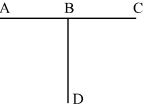
- 6Three conducting rods of same material and cross-section are shown in figure. Temperatures of$ A, D$ and $C$ are maintained at $20^o C, 90^o C$ and $0^o C$. The ratio of lengths of $BD$ and $BC$ if there is no heat flow in $AB$ is:View Solution
- 7View SolutionWhich of the following is best close to an ideal black body
- 8Two identical beakers $A$ and $B$ contain equal volumes of two different liquids at $60\,^oC$ each and left to cool down. Liquid in $A$ has density of $8 \times10^2\, kg / m^3$ and specific heat of $2000\, Jkg^{-1}\,K^{-1}$ while liquid in $B$ has density of $10^3\,kgm^{-3}$ and specific heat of $4000\,JKg^{-1}\,K^{-1}$ . Which of the following best describes their temperature versus time graph schematically? (assume the emissivity of both the beakers to be the same)View Solution
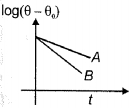
- 9Two bodies $A$ and $B$ of equal masses, area and emissivity cooling under Newton's law of cooling from same temperature are represented by the graph. If $\theta$ is the instantaneous temperature of the body and $\theta_0$ is the temperature of surroundings, then relationship between their specific heats is ..........View Solution
- 10View SolutionIf black wire of platinum is heated, then its colour first appear red, then yellow and finally white. It can be understood on the basis of