Question
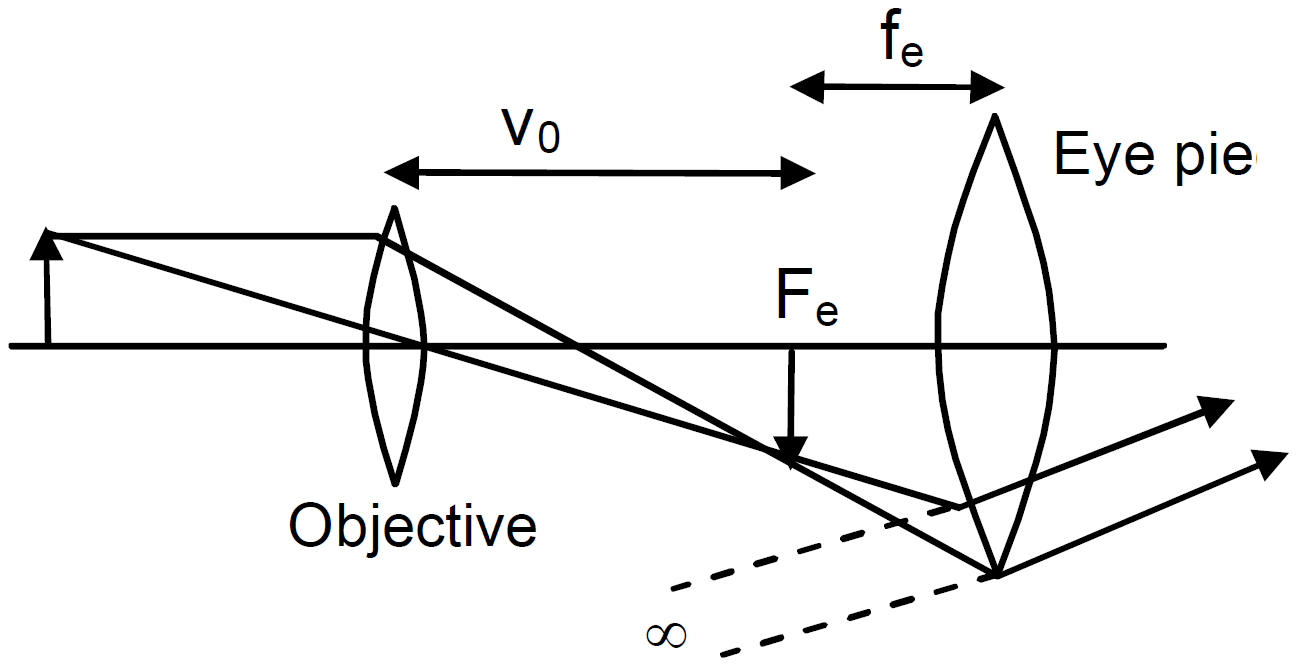
A compound microscope has a magnifying power of 100 when the image is formed at infinity. The objective has a focal length of 0.5cm and the tube length is 6.5cm. Find the focal length of the eyepiece.
Answer

For the give compound microscope, $f_0 = 0.5cm$, tube length = 6.5cm magnifying power = 100 (normal adjustment) Since, the image is formed at infinity, the real image produced by the objective lens should lie on the focus of the eye piece. So, $v_o + f_e = 6.5cm ...(1)$
Again, magnifying power $\text{m}=\frac{\text{v}_0}{\text{u}_0}\times\frac{\text{D}}{\text{f}_\text{e}}$ [for normal adjustment]
$\Rightarrow\text{m}=\Big[1-\frac{\text{V}_0}{\text{f}_0}\Big]\frac{\text{D}}{\text{f}_\text{e}}$
$\Rightarrow100=-\Big[1-\frac{\text{V}_0}{0.5}\Big]\times\frac{25}{\text{f}_\text{e}}$ [Taking D = 25cm]
$\Rightarrow100\text{f}_\text{e}=-(1-2\text{v}_0)\times25$
$\Rightarrow2\text{v}_0-4\text{f}_\text{e}=1 $ ...(2)
Solving equation (1) and (2) we can get,
$V_0 = 4.5cm$ and $f_e = 2cm$
So, the focal length of the eye piece is 2cm.

Need a full question paper?

Generate a complete, print-ready paper with questions like this in minutes — across 16+ boards, with answer keys.
Start Generating Free

Similar questions

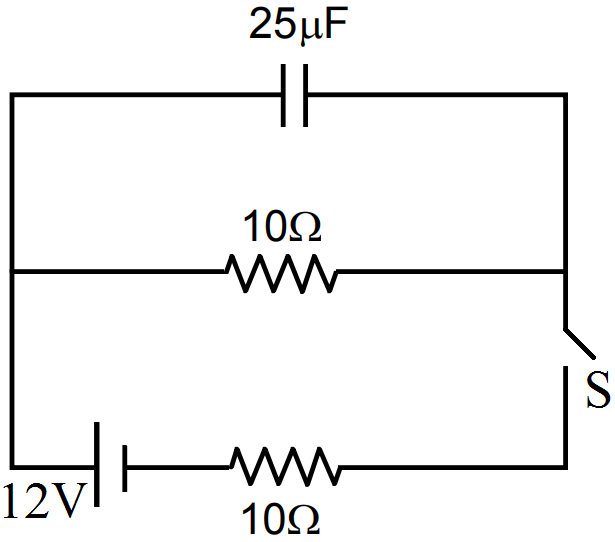
The switch S shown in figure. is kept closed for a long time and is then opened at t = 0. Find the current in the middle $1.0\Omega$ resistor at t = 1ms.
Find the maximum magnitude of the linear momentum of a photoelectron emitted when light of wavelength 400 run falls on a metal having work function 2.5eV.
A proton and an α-particle are accelerated, using the same potential difference. How are the de-Broglie wavelengths $\lambda _p$ and $\lambda _a$​​​​​​​ related to each other?
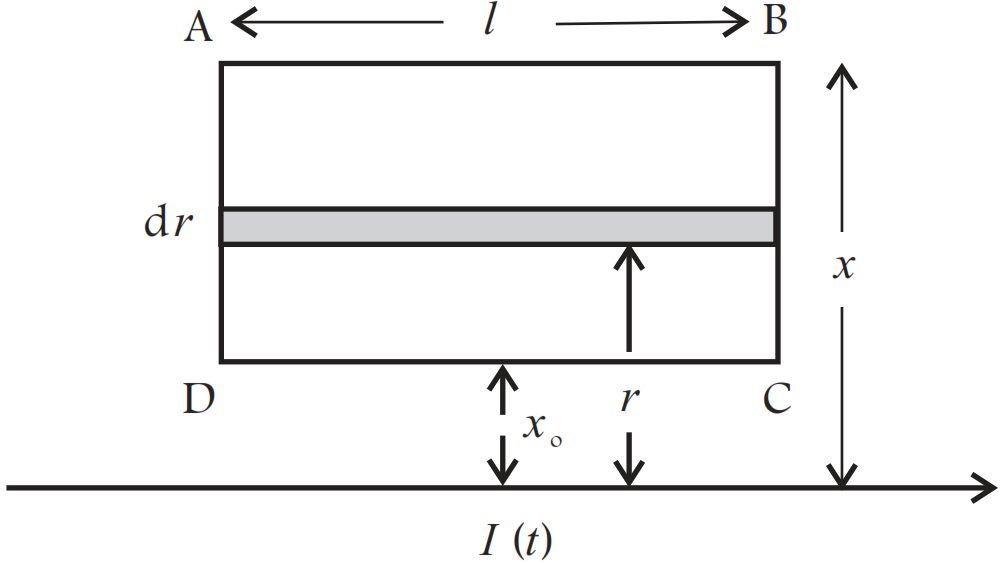
Consider an infinitely long wire carrying a current I (t), with $\frac{\text{dI}}{\text{dt}}=\lambda=\text{constant}$. Find the current produced in the rectangular loop of wire ABCD if its resistance is R (Fig).
Two tiny spheres carrying charges 1.5 µC and 2.5 µC are located 30 cm apart. Find the potential and electric field:
  1. At the mid-point of the line joining the two charges, and
  2. At a point 10 cm from this midpoint in a plane normal to the line and passing through the mid-point.
A square loop of side 12 cm with its sides parallel to $X$ and $Y$ axes is moved with a velocity of $8 \mathrm{cms}^{-1}$ in the positive $x$-direction in an environment containing a magnetic field in the positive z-direction. The field is neither uniform in space nor constant in time. It has a gradient of $10^{-3} \mathrm{~T} \mathrm{~cm}^{-1}$ along the negatilve x -direction (that is it increases by $10^{-3} \mathrm{~T} \mathrm{~cm}^{-1}$ as one moves in the negative $x$-direction), and it is decreasing in time at the rate of $10^{-3} \mathrm{Ts}^{-1}$. Determine the direction and magnitude of the induced current in the loop if its resistance is $4.50 \mathrm{~m} \Omega$.
Find the wavelength of the radiation emitted by hydrogen in the transitions (a) n = 3 to n= 2, (b) n = 5 to n = 4 and (c) n = 10 to n = 9.
Explain the uses of Polaroid.
(i) Obtain an expression for torque acting on a rectangular current carrying coil in a uniform magnetic field. (ii) Calculate magnetic dipole of a circular electric current loop.
Obtain the amount of $^{60}_{27}\text{Co}$ necessary to provide a radioactive source of 8.0 mCi strength. The half-life of $^{60}_{27}\text{Co}$ is 5.3 years.