Question
A compound microscope is an optical instrument used for observing highly magnified images of tiny objects. Magnifying power of a compound microscope is defined as the ratio of the angle subtended at the eye by the final image to the angle subtended at the eye by the object, when both the final image and the object are situated at the least distance of distinct vision from the eye. It can be given that: $m = m_e \times m_0,$ where $m_e$ is magnification produced by eye lens and m0 is magnification produced by objective lens.
Consider a compound microscope that consists of an objective lens of focal length 2.0cm and an eyepiece of focal length 6.25cm separated by a distance of 15cm.
  1. The object distance for eye-piece, so that final image is formed at the least distance of distinct vision, will be:
  1. 3.45cm
  2. 5cm
  3. 1.29cm
  4. 2.59cm
  1. How far from the objective should an object be placed in order to obtain the condition described in part (i)?
  1. 4.5cm
  2. 2.5cm
  3. 1.5cm
  4. 3.0cm
  1. What is the magnifying power of the microscope in case of least distinct vision?
  1. 20
  2. 30
  3. 40
  4. 10
  1. The intermediate image formed by the objective of a compound microscope is:
  1. Real, inverted and magnified.
  2. Real, erect, and magnified.
  3. Virtual, erect and magnified.
  4. Virtual, inverted and magnified.
  1. The magnifying power of a compound microscope increases with:
  1. The focal length of objective lens is increased and that of eye lens is decreased.
  2. The focal length of eye lens is increased and that of objective lens is decreased.
  3. Focal lengths of both objects and eye-piece are increased.
  4. Focal lengths of both objects and eye-piece are decreased.
Answer

  1. (b) 5cm
Explanation:
Here, $f_0 = 2.0, f_e = 6.25cm, u_0 = ?$
When the final image is obtained at the least distance of distinct vision:
$v_e = -25cm$
As $\frac{1}{\text{v}_\text{e}}-\frac{1}{\text{}_\text{e}}=\frac{1}{\text{f}_\text{e}}$
$\therefore\frac{1}{\text{u}_\text{e}}\frac{1}{\text{v}_\text{e}}\frac{1}{\text{f}_\text{e}}=\frac{1}{-25}-\frac{1}{6.25}$
$=\frac{-1-4}{25}=\frac{-5}{25}=-\frac{1}{5}$
or $\text{u}_\text{e}=-5\text{cm}$
  1. (b) 2.5cm
Explanation:
Distance between objective and eye-piece = 15cm
$\therefore$ Distance of the image from objective is $\text{v}_0=15-5=10\text{cm}$
$\therefore\frac{1}{\text{u}_0}=\frac{1}{\text{v}_0}-\frac{1}{\text{f}_0}=\frac{1}{\text{10}}-\frac{1}{\text{2}}=\frac{1-5}{\text{10}}=-\frac{2}{5}$
or $\text{u}_0=-\frac{5}{2}=-2.5\text{cm}$
$\therefore$ Distance of object from objective = 2.5cm
  1. (a) 20
Explanation:
Magnifying power,
$\text{m}=\text{m}_0\times\text{m}_\text{e}=\frac{\text{v}_0}{\text{u}_0}(1+\frac{\text{D}}{\text{fe}})=\frac{10}{2.5}(1+\frac{25}{6.25})=20$
  1. (a) Real, inverted and magnified.
Explanation:
The intermediate image formed by the objective of a compound microscope is real, inverted and magnified.
  1. (d) Focal lengths of both objects and eye-piece are decreased.
Need a full question paper?

Generate a complete, print-ready paper with questions like this in minutes — across 16+ boards, with answer keys.

Start Generating Free

Similar questions

Explain the reverse blas characteristics of $p-n$ junction diode with proper graph.
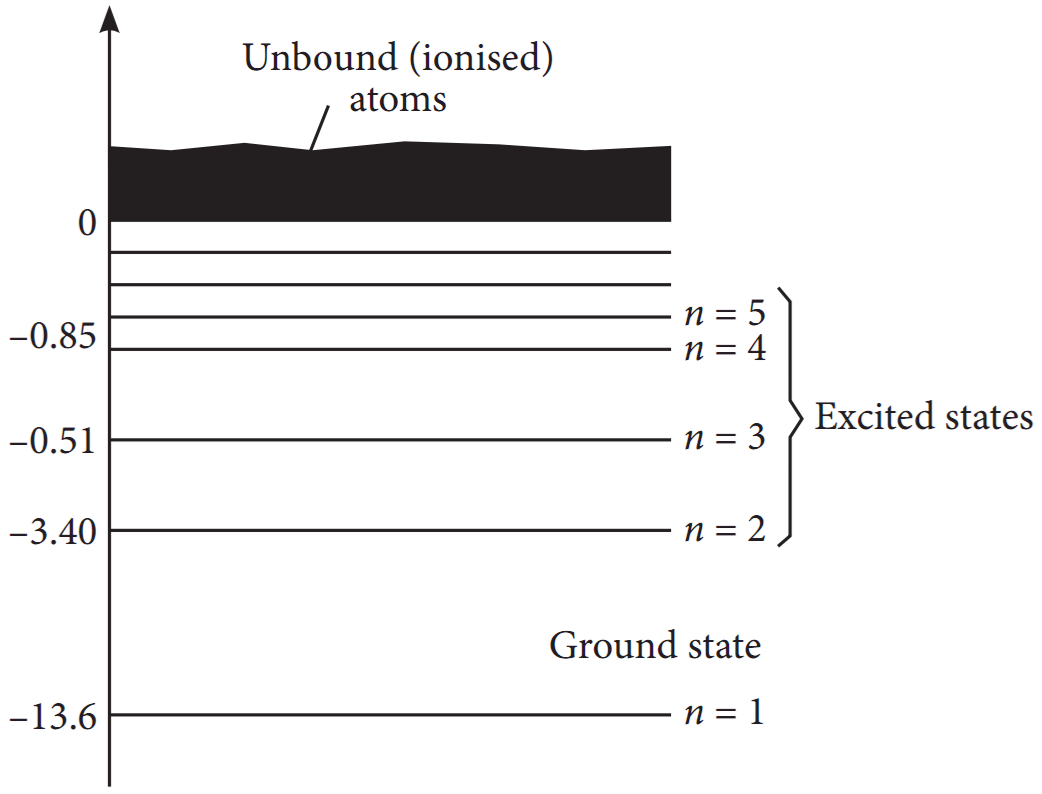
At room temperature, most of the H-atoms are in ground state. When an atom receives some energy (i.e., by electron collisions), the atom may acquire sufficient energy to raise electron to higher energy state. In this condition, the atom is said to be in excited state. From the excited state, the electron can fall back to a state of lower energy emitting a photon equal to the energy difference of the orbit.

In a mixture of He-He gas $(He^+$ is singleionized He atom$)$. H-atoms and $He^+$ ions are excited to their respective first excited states. Subsequently, H-atoms transfer their total excitation energy to $He^+$ ions (by collisions)
  1. The quantum number n of the state finally populated in $He^+$ ions is.
  1. 2
  2. 3
  3. 4
  4. 5
  1. The wavelength of light emitted in the visible region by $He^+$ ions after collisions with H-atoms is.
  1. $6.5 \times 10^{-7} m$
  2. $5.6 \times 10^{-7} m$
  3. $4.8 \times 10^{-7} m$
  4. $4.0 \times 10^{-7} m$
  1. The ratio of kinetic energy of the electrons for the H-atoms to that of $He^+$ ion for n = 2 is.
  1. $\frac{1}{4}$
  2. $\frac{1}{2}$
  3. 1
  4. 2
  1. The radius of the ground state orbit of H-atoms is.
  1. $\frac{\in_0}{\text{h}\pi\text{me}^2}$
  2. $\frac{\text{h}^2\in_0}{\pi\text{me}^2}$
  3. $\frac{\pi\text{me}^2}{\text{h}}$
  4. $\frac{2\pi\text{h}\in_0}{\text{me}^2}$
  1. Angular momentum of an electron in H-atom in first excited state is.
  1. $\frac{\text{h}}{\pi}$
  2. $\frac{\text{h}}{2\pi}$
  3. $\frac{2\pi}{\text{h}}$
  4. $\frac{\pi}{\text{h}}$
Complete the following table:
Car Model
Driver X
Reaction time 0.20s
Driver Y
Reaction time 0.30s
$A ($deceleration on hard braking $= 6.0m/s^2)$
Speed = 54km/h
Braking distance
a = ...
Total stopping distance
b = ...
Speed = 72km/h
Braking distance
c = ...
Total stopping distance
d = ...
$B ($deceleration on hard braking $= 7.5m/s^2)$
Speed = 54km/h
Breaking distance
e = ...
Total stopping distance
f = ...
Speed 72km/h
Braking distance
g = ...
Total stopping distance
h = ...
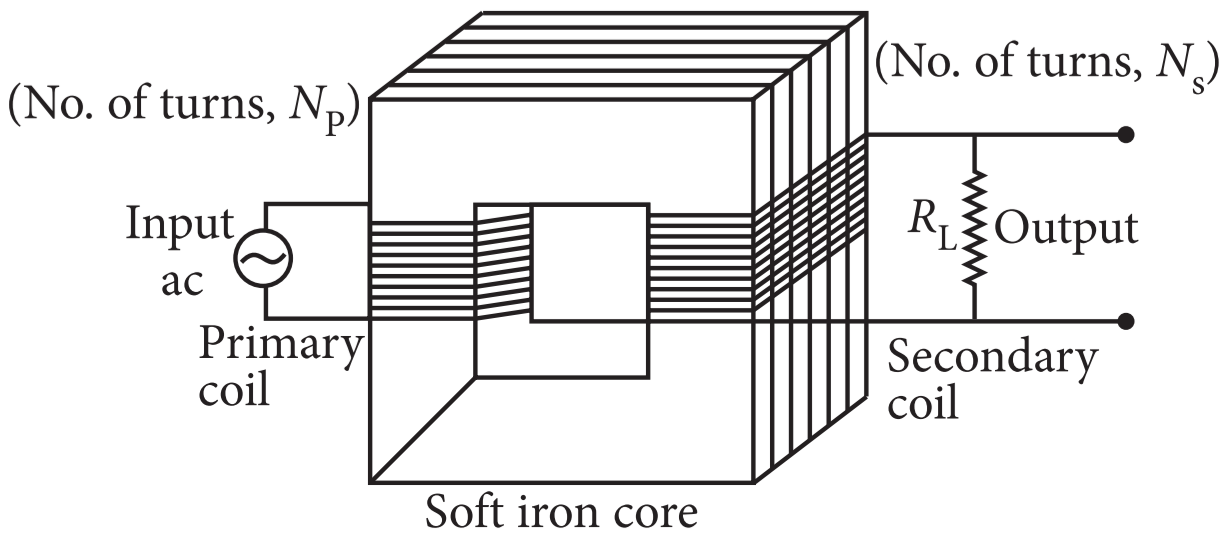
A transformer is an electrical device which is used for changing the a.c. voltages. It is based on the phenomenon of mutual induction i.e. whenever the amount of magnetic flux linked with a coil changes, an e.m.f. is induced in the neighbouring coil. For an ideal transformer, the resistances of the primary and secondary windings are negligible.

It can be shown that $\frac{\text{E}_\text{S}}{\text{E}_\text{P}}=\frac{\text{I}_\text{P}}{\text{I}_\text{S}}=\frac{\text{n}_\text{S}}{\text{n}_\text{P}}=\text{K}$
where the symbols have their standard meanings.
For a step up transformer, $\text{n}_\text{S} > \text{n}_\text{P}; \text{E}_\text{S} > \text{E}_\text{P}; \text{k} > \text{I}; \therefore \text{I}_\text{S} < \text{I}_\text{P}$
For a step down transformer, $\text{n}_\text{S} > \text{n}_\text{P}; \text{E}_\text{S} > \text{E}_\text{P}; \text{k} > \text{I};$
The above relations are on the assumptions that efficiency of transfonner is 100%.
lnfact, efficiency $\eta=\frac{\text{output power}}{\text{intput power }}=\frac{\text{E}_\text{S}\text{I}_\text{S}}{\text{E}_\text{P}\text{I}_\text{P}}$
  1. Which of the following quantity remains constant in an ideal transformer?
  1. Current.
  2. Voltage.
  3. Power.
  4. All of these.
  1. Transformer is used to.
  1. Convert ac to de voltage.
  2. Convert de to ac voltage.
  3. Obtain desired de power.
  4. Obtain desired ac voltage and current.
  1. The number of tums in primary coil of a transformer is 20 and the number of turns in a secondary is 10. If the voltage across the primary is ac 220V, what is the voltage across the secondary?
  1. ac 100V
  2. ac 120V
  3. ac 110V
  4. ac 220V
  1. In a transformer the number of primary turns is four times that of the secondary turns. Its primary is connected to an a.c. source of voltage V. Then,
  1. Current through its secondary is about four times that of the current through its primary.
  2. Voltage across its secondary is about four times that of the voltage across its primary.
  3. Voltage across its secondary is about two times that of the voltage across its primary.
  4. voltage across its secondary is about $\frac{1}{2\sqrt{2}}$ times that of the voltage across its primary.
  1. A transformer is used to light 100W-110V lamp from 220V mains. If the main current is 0.5A, the efficiency of the transformer is:
  1. 95%
  2. 99%
  3. 90%
  4. 96%
A capacitor is a device to store energy. The process of charging up a capacitor involves the transferring of electric charges from its one place to another. This work done in charging the capacitor is stored as its electrical potential energy.
If q is the charge and V is the potential difference across a capacitor at any instant during its charging, then small work done in storing an additional small charge dq against the repulsion of charge q already stored on it is $\text{dW}=\text{V.dq}=(\frac{\text{q}}{\text{C}})\text{dq}.$
  1. A system of 2 capacitors of capacitance $2\mu\text{F}$ and $4\mu\text{F}$ is connected in series across a potential difference of 6 V. The energy stored in the system is:
  1. $3\mu\text{J}$
  2. $24\mu\text{J}$
  3. $30\mu\text{J}$
  4. $108\mu\text{J}$
  1. A capacitor of capacitance of $10\mu\text{F}$ is charged to 10V. The energy stored in it is:
  1. $100\mu\text{J}$
  2. $500\mu\text{J}$
  3. $1000\mu\text{J}$
  4. $1\mu\text{J}$
  1. A parallel plate air capacitor has capacity C farad, potential V volt and energy E joule. When the gap between the plates is completely filled with dielectric:
  1. Both V and E increase.
  2. Both V and E decrease.
  3. V decreases, E increases.
  4. V increases, E decreases.
  1. A capacitor with capacitance $5\mu\text{F}$ s charged to $5\mu\text{C}.$ If the plates are pulled apart to reduce the capacitance to $2\mu\text{F},$ how much work is done?
  1. $6.25 \times 10^{-6}J$
  2. $3.75 \times 10^{-6}J$
  3. $2.16 \times 10^{-6}J$
  4. $2.55 \times 10^{-6}J$
  1. A metallic sphere ofradius 18cm has been given a charge of $5 \times 10^{-6}C$. The energy of the charged conductor is:
  1. 0.2J
  2. 0.6J
  3. 1.2J
  4. 2.4J
When you push your bicycle up on an incline the potential energy of the bicyle and yourself increases. Where does this energy come from?
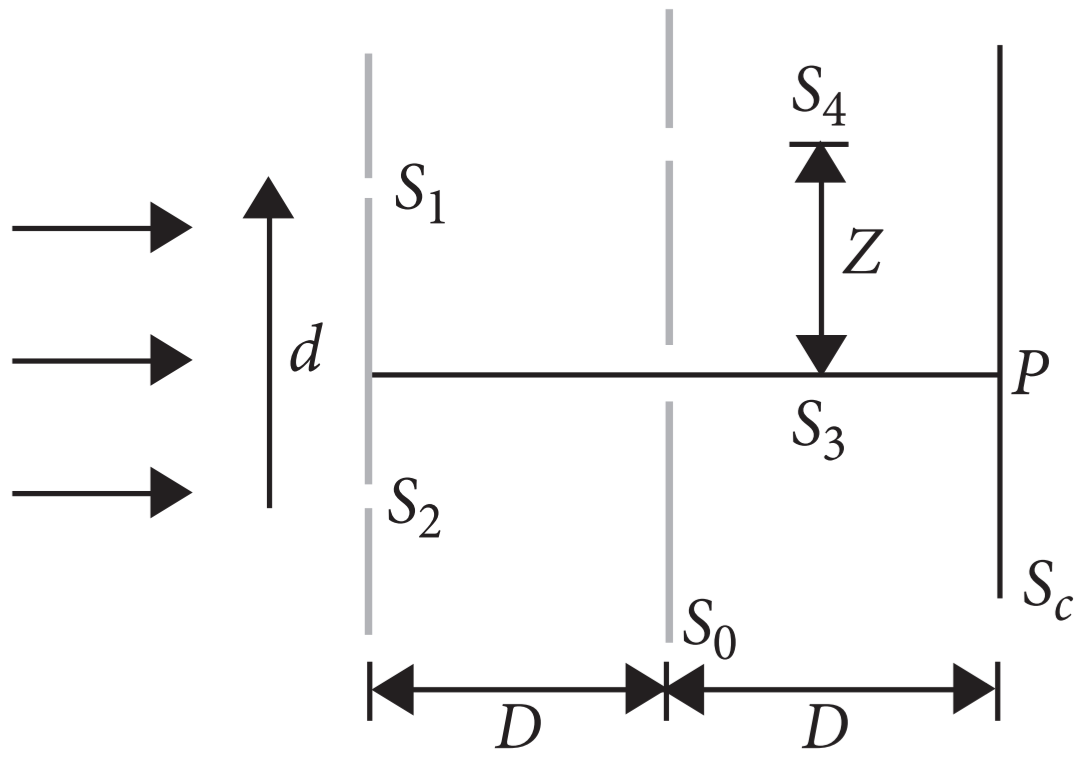
Consider the situation shown in figure. The two slits $S_1$ and $S_1$ placed symmetrically around the central line are illuminated by monochromatic light of wavelength $\lambda$. The separation between the slits is d. The light transmitted by the slits falls on a screen $S_0$ place at a distance D from the slits. The slits $S_3$ is at the central line and the slit $S_4$ is at a distance from $S_3.$ Another screen $S_c$ is placed a further distance D away from $S_c.$
  1. Find the path difference if $\text{z}=\frac{\lambda\text{D}}{2\text{d}}$.
  1. $\lambda$
  2. $\frac{\lambda}{2}$
  3. $\frac{3}{2\lambda}$
  4. $2\lambda$
  1. Find the ratio of the maximum to minimum intensity observed on $S_c$ if $\text{z}=\frac{\lambda\text{D}}{\text{d}}$
  1. 4
  2. 2
  3. $\infty$
  4. 1
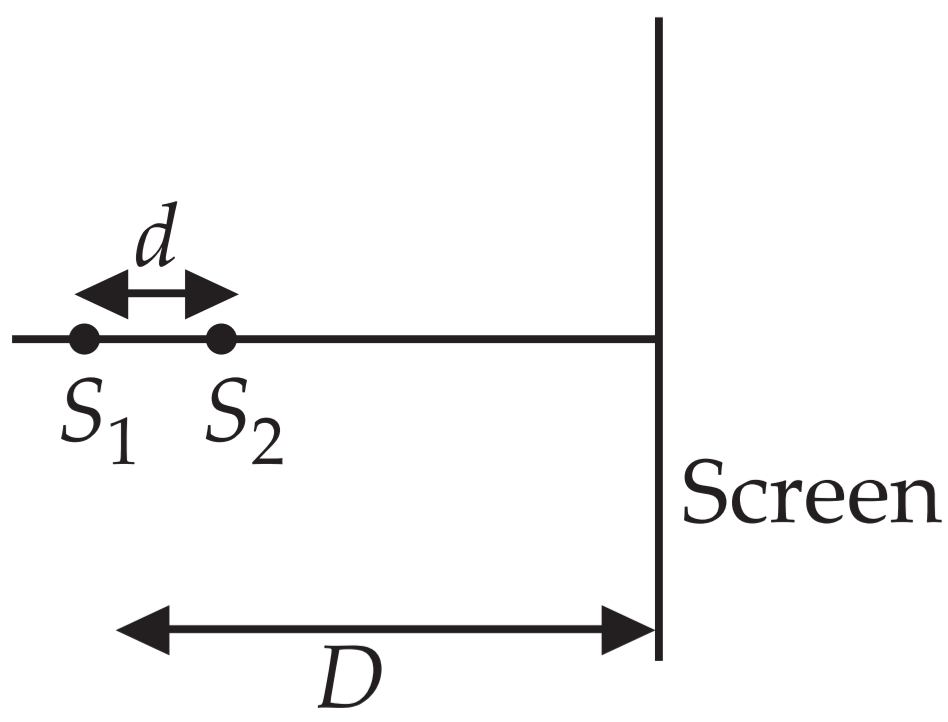
  1. Two coherent point sources $S_1$ and $S_2$ are separated by a small distanced as shown in figure. The fringes obtained on the screen will be:
  1. Concentric circles.
  2. Points.
  3. Straight lines.
  4. Semi-circles.
  1. ln the case of light waves from two coherent sources $S_1$ and $S_2$, there will be constructive interference at an arbitrary point P, if the path difference $S_1P - S_2P$ is:
  1. $\Big(\text{n}+\frac{1}{2}\Big)\lambda$
  2. $\text{n}\lambda$
  3. $\Big(\text{n}-\frac{1}{2}\Big)\lambda$
  4. $\frac{\lambda}{2}$
  1. Two monochromatic light waves of amplitudes $3_A$ and $2_A$ interfering at a point have a phase difference of 60º. The intensity at that point will be proportional to:
  1. $5A^2$
  2. $13A^2$
  3. $7A^2$
  4. $19A^2$
A bar magnet whose area of cross-section is $0.25 cm^2$ is kept in a magnetising field of intensity of $5000 A / m$. If magnitude of magnetic flux passing through the bar is $2.5 \times 10^{-5}$ weber, then calculate :(a) Magnetic induction (b) Magnetic susceptibility (c) Intensity of magnetisation.
In an a.c. circuit, values of voltage and current change every instant. Therefore, power of an a.c. circuit at any instant is the product of instantaneous voltage (E) and instantaneous current (I). The average power supplied to a pure resistance R over a complete cycle of a.c. is $\text{P} = \text{E}_\text{V}\text{I}_\text{V}.$ When circuit is inductive, average power per cycle is $\text{E}_\text{V}\text{I}_\text{V}\cos\phi.$

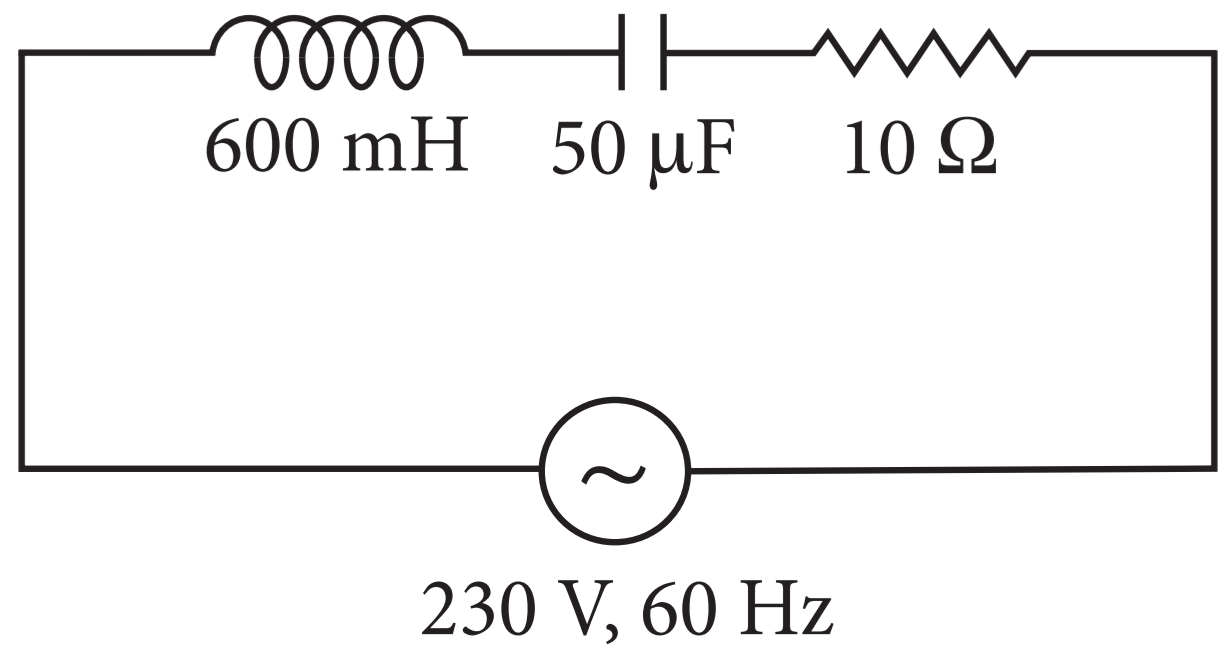
In an a.c. circuit, 600mH inductor and a $15\Omega$ capacitor are connected in series with $10\Omega$ resistance. The a.c. supply to the circuit is 230V, 60Hz.
  1. The average power transferred per cycle to resistance is:
  1. 10.42W
  2. 15.25W
  3. 17.42W
  4. 13.45W
  1. The average power transferred per cycle to capacitor is:
  1. Zero
  2. 10.42W
  3. 17.42W
  4. 15W
  1. The average power transferred per cycle to inductor is:
  1. 25W
  2. 17.42W
  3. 16.52W
  4. Zero
  1. The total power transferred per cycle by all the three circuit elements is:
  1. 17.42W
  2. 10.45W
  3. 12.45W
  4. Zero
  1. The electrical energy spend in running the circuit for one hour is:
  1. $7.5 \times 10^5$ Joule
  2. $10 \times 10^3 $ Joule
  3. $9.4 \times 10^3$ Joule
  4. $6.2 \times 10^4$ Joule
For a circular coil of radius R and N turns carrying current I, the magnitude of the magnetic field at a point on its axis at a distance x from its centre is given by,
$\text{B}=\frac{\mu_{0}\text{IR}^{2}\text{N}}{2(\text{x}^{2}+\text{R}^{2})^{\frac{3}{2}}}$
  1. Show that this reduces to the familiar result for field at the centre of the coil.
  2. Consider two parallel co-axial circular coils of equal radius R, and number of turns N, carrying equal currents in the same direction, and separated by a distance R. Show that the field on the axis around the mid-point between the coils is uniform over a distance that is small as compared to R, and is given by,$\text{B}=0.72\frac{\mu_{0}\text{NI}}{\text{R}}$, approximately.
[Such an arrangement to produce a nearly uniform magnetic field over a small region is known as Helmholtz coils.]