Question
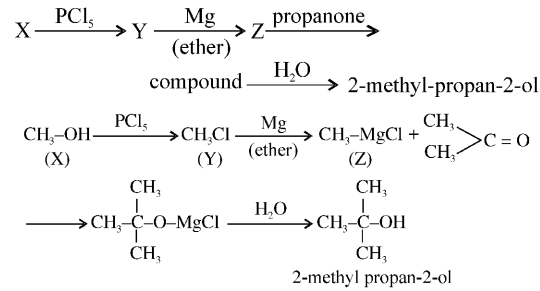
A compound (X) reacts with PCl5 to form compound Y. Compound Y reacts with ethereal solution of magnesium to form compound (Z), which on treating with propanone and further hydrolysis to give 2-Methyl propan-2-ol. What are the compounds X and Y and also give the equations of the reactions.
Answer

The final product is 3º alcohol of four carbon, which is obtained by reacting compound Z with propanone. Therefore compound Z is a carbon containing Grignard reagent, hence the starting compound will be a alcohol having one carbon. The reaction sequence will be as follows:
Image

Need a full question paper?

Generate a complete, print-ready paper with questions like this in minutes — across 16+ boards, with answer keys.

Start Generating Free

Similar questions

Calculate the standard cell potentials of galvanic cell in which the following reactions take place:
Fe2+(aq) + Ag+ (aq) → Fe3+(aq) + Ag(s)
Calculate the $\triangle_\text{r}\text{G}^\ominus$ and equilibrium constant of the reactions.
Write the reactions taking place at the anode and cathode in the above cell.
An optically active compound having molecular formula C6H12O6 is found in two isomeric forms (A) and (B) in nature. When (A) and (B) are dissolved in water, they show the following equilibrium.
$(\text{A})\ \ \ \ \rightleftharpoons\ \ \ \ \text{Equilibrium mixture}\ \ \ \ \rightleftharpoons\ \ \ \ \text{(B)}\\ [\alpha]_{\text{D}}=111^\circ\ \ \ \ \ \ \ \ \ \ \ \ \ \ 52.2^\circ\ \ \ \ \ \ \ \ \ \ \ \ \ \ \ \ \ \ \ \ \ \ \ \ \ \ 19.2^\circ$
  1. What are such isomers called?
  2. Can they be called enantiomers? Justify your answer.
  3. Draw the cyclic structure of isomer (A).
Colour of KMnO4 disappears when oxalic acid is added to its solution in acidic medium.
Calculate the potential for half-cell containing
0.10M K2Cr2O7 (aq), 0.20M Cr3+(aq) and 1.0 × 10⁻⁴M H+(aq). The half cell reaction is
$\text{Cr}_2\text{O}_7^{2-}(\text{aq})14\text{H}^+(\text{aq})+6\text{e}^-\xrightarrow{ \ \ \ \ \ \ \ \ \ \ }2\text{Cr}^{3+}(\text{aq})+7\text{H}_2\text{O}(\text{l})$
and the standard electrode potential is given as E° = 1.33V.
Explain electrolysis of concentration aqueous solution of NaCl
In a pseudo first order hydrolysis of ester in water, the following results were obtained:
t/s 0 30 60 90
[Ester]/mol L-1 0.55 0.31 0.17 0.085
  1. Calculate the average rate of reaction between the time interval 30 to 60 seconds.
  2. Calculate the pseudo first order rate constant for the hydrolysis of ester.
Explain mechanism of nucleophilic addition reaction of aldehydes and ketones with figure.
A solution containing 30 g of non-volatile solute exactly in 90 g of water has a vapour pressure of 2.8 kPa at 298 K. Further, 18 g of water is then added to the solution and the new vapour pressure becomes 2.9 kPa at 298 K. Calculate:
  1. Molar mass of the solute.
  2. Vapour pressure of water at 298 K.
What is a peptide bond or peptide chain? Elaborate on how protein compounds are formed from amino acid compounds.