A condenser having a capacity of $6\,\mu F$ is charged to $100\, V$ and is then joined to an uncharged condenser of $14\,\mu F$ and then removed. The ratio of the charges on $6\,\mu F$ and $14\,\mu F$ and the potential of $6\,\mu F$ will be
Medium
Download our app for free and get started
(c) Let ${q_1},\,{q_2}$ be the charges on two condensers
$V = \frac{{{q_1}}}{6} = \frac{{{q_2}}}{{14}}$
$V = \frac{{{q_1}}}{6} = \frac{{{q_2}}}{{14}}$
$==>$ $\frac{{{q_1}}}{{{q_2}}} = \frac{6}{{14}} = \frac{3}{7}$
Also ${q_1} + {q_2} = 600$
$==>$ ${q_1} + \frac{{14}}{6}{q_1} = 600$
$==>$ ${q_1} = \frac{{600}}{{20}} \times 6$
$V = \frac{{{q_1}}}{6} = \frac{{600}}{{20}} = 30\,volt$

Download our appand get started for free
Experience the future of education. Simply download our apps or reach out to us for more information. Let's shape the future of learning together!No signup needed.*
Similar Questions
- 1Sixty four conducting drops each of radius $0.02 m$ and each carrying a charge of $5 \,\mu C$ are combined to form a bigger drop. The ratio of surface density of bigger drop to the smaller drop will be ............View Solution
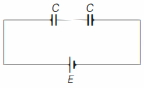
- 2Two identical parallel plate capacitors of capacitance $C$ each are connected in series with a battery of emf, $E$ as shown below. If one of the capacitors is now filled with a dielectric of dielectric constant $k$, then the amount of charge which will flow through the battery is (neglect internal resistance of the battery)View Solution
- 3A parallel plate capacitor has capacitance $C$. If it is equally filled with parallel layers of materials of dielectric constants $K_1$ and $K_2$ its capacity becomes $C_1$. The ratio of $C_1$ to $C$ isView Solution
- 4$64$ small drops of mercury, each of radius $ r$ and charge $q$ coalesce to form a big drop. The ratio of the surface density of charge of each small drop with that of the big drop isView Solution
- 5An electric dipole of moment $p$ is placed in the position of stable equilibrium in uniform electric field of intensity $E$. It is rotated through an angle $\theta $ from the initial position. The potential energy of electric dipole in the final position isView Solution
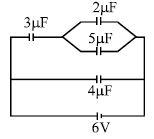
- 6In the circuit shown in figure, the ratio of charges on $5\ \mu F$ and $4\ \mu F$ capacitor is :View Solution
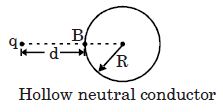
- 7View SolutionFor the situation shown in the figure below, mark out the correct statement
- 8Three concentric metallic shells $A, B$ and $C$ of radii $a, b$ and $c (a < b < c)$ have surface charge densities $\sigma ,\, - \sigma $ and $\sigma $ respectively. then ${V_A}$ and ${V_B}$View Solution
- 9The minimum number of capacitors each of $2$ $\mu F$ required to make a circuit with an equivalent capacitance $5$ $\mu F$ isView Solution
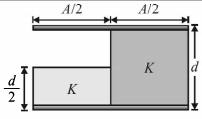
- 10A parallel plate capacitor of area ' $A$ ' plate separation ' $d$ ' is filled with two dielectrics as shown. What is the capacitance of the arrangement?View Solution