Question
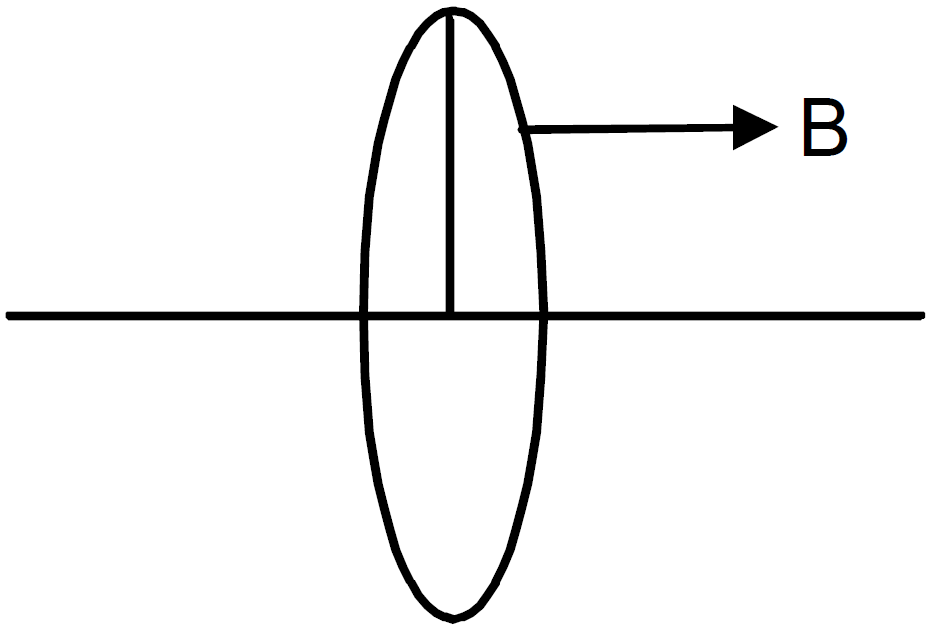
A conducting disc of radius r rotates with a small but constant angular velocity $\omega$ about its axis. A uniform magnetic field B exists parallel to the axis of rotation. Find the motional emf between the centre and the periphery of the disc.
Answer


V at a distance $\frac{\text{r}}{2}$
From the centre $=\frac{\text{r}\omega}{2}$
$\text{E}=\text{BlV}$
$\Rightarrow\text{E}=\text{B}\times\text{r}\times\frac{\text{r}\omega}{2}=\frac{1}{2}\text{B}\text{r}^2\omega$

Need a full question paper?

Generate a complete, print-ready paper with questions like this in minutes — across 16+ boards, with answer keys.

Start Generating Free

Similar questions

A light bulb and a solenoid are connected in series across an ac source of voltage. Explain, how the glow of the light bulb will be affected when an iron rod is inserted in the solenoid.
In 1959 Lyttleton and Bondi suggested that the expansion of the Universe could be explained if matter carried a net charge. Suppose that the Universe is made up of hydrogen atoms with a number density N, which is maintained a constant. Let the charge on the proton be: $e_p= -(1 + y)e$ where e is the electronic charge.
Show that the velocity of expansion is proportional to the distance from the centre.
A wire-loop confined in a plane is rotated in its own plane with some angular velocity. A uniform magnetic field exists in the region. Find the emf induced in the loop.
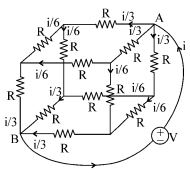
If 12 resistances each of $12 \Omega$ resistance are joined in a cubical network, then calculate the equivalent resistance at the corners opposite to diagonals of this network.
Image
What is the power dissipated by an ideal inductor in ac circuit? Explain.
Write down the equation of electric potential for a point $-$ outside the spherical shell $-$ on the surface of a spherical shell and $-$ inside the spherical shell.
Show that the radius of the orbit in hydrogen atom varies as n2, where n is the principal quantum number of the atom.
Explain electricity conduction in intrinsic semi-conductors.
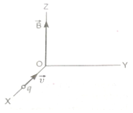
As shown in figure, a charge q moving along the X -axis with a velocity $\vec{v}$ is subjected to a uniform magnetic field $\vec{B}$ acting along the Z-axis as it crosses the origin O.
Image
i. Trace its trajectory.
ii. Does the charge gain kinetic energy, as it enters the magnetic field? Justify your answer.
Explain the unit of energy $e{V}$ (electron volt) and define 1 eV .