A constant electric current $I$ is passed through a straight conductor of length $l$. If $S$ in specific charge of electron then the total momentum of electrons is
Medium


Download our appand get started for free
Experience the future of education. Simply download our apps or reach out to us for more information. Let's shape the future of learning together!No signup needed.*
Similar Questions
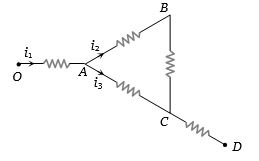
- 1The current in the arm $CD$ of the circuit will beView Solution
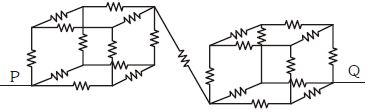
- 2Find the equivalent resistance between $P$ and $Q.$ (If each wire has a resistance $R$ )View Solution
- 3When the resistance of $9 \,\Omega$ is connected at the ends of a battery, its potential difference decreases from $40\, volt$ to $30\, volt$. The internal resistance of the battery is ............... $\Omega$View Solution
- 4The resistivity $(\rho)$ of semiconductor varies with temperature. Which of the following curve represents the correct behaviourView Solution
- 5This question contains statement$-1$ and statement$-2$. Of the four choices given after the statements, choose the one that best describes the two statements.View Solution
statement$-1$ : The temperature dependence of resistance is usually given as $R=R_{0}(1+\alpha \Delta t)$. The resistance of a wire changes from $100\; \Omega$ to $150\; \Omega$ when its temperature is increased from $27^{\circ} C$ to $227^{\circ} C$. This implies that $\alpha=2.5$ $\times 10^{-3} /{ }^{\circ} C$
statement$-2\;: R=R_{0}(1+\alpha \Delta t)$ is valid only when the change in the temperature $\Delta T$ is small and $\Delta R=\left(R-R_{0}\right) < < R_{0}$
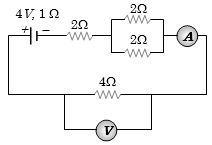
- 6What is the equivalent resistance of the circuit ............. $\Omega$View Solution
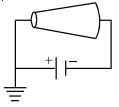
- 7$A$ conductor is made of an isotropic material and has shape of a truncated cone. $A$ battery of constant emf is connected across it and its left end is earthed as shown in figure. If at a section distant $x$ from left end, electric field intensity, potential and the rate of generation of heat per unit length are $E, V$ and $H$ respectively, which of the following graphs is are correct?View Solution
- 8Assume a hypothetical wire in which free electron density changes with temperature in proportionality $n\ \alpha \ T$ assuming $\tau $(Relaxation time of collision) and dimensions of wire remain unchanged with increasing temperature. Which one of the resistance $v/s$ temperature graph is trueView Solution
- 9Two sources of equal $emf$ are connected to an external resistance $R$. The internal resistances of the two sources are ${R_1}$ and ${R_2}\,({R_2} > {R_1})$. If the potential difference across the source having internal resistance ${R_2}$ is zero, thenView Solution
- 10Heater of electric kettle is made of a wire of length $L$ and diameter $d$. It takes $4$ minutes to raise the temperature of $0.5 \ kg$ water by $40\ K$. This heater is replaced by a new heater having two wires of the same material, each of length $L$ and diameter $2 d$. The way these wires are connected is given in the options. How much time in minutes will it take to raise the temperature of the same amount of water by $40K$ ?View Solution
$(A)$ $4$ if wires are in parallel
$(B)$ $2$ if wires are in series
$(C)$ $1$ if wires are in series
$(D)$ $0.5$ if wires are in parallel.