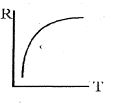
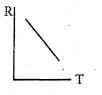
Assume a hypothetical wire in which free electron density changes with temperature in proportionality $n\ \alpha \ T$ assuming $\tau $(Relaxation time of collision) and dimensions of wire remain unchanged with increasing temperature. Which one of the resistance $v/s$ temperature graph is true
A
B
C
D
Medium
Download our app for free and get started
A
a $R = \left( {\frac{{2lm}}{{{e^2}\tau A}}} \right)\frac{1}{n}$
Download our app
and get started for free
Experience the future of education. Simply download our apps or reach out to us for more information. Let's shape the future of learning together!No signup needed.*
In a Wheatstone’s bridge all the four arms have equal resistance $R$. If the resistance of the galvanometer arm is also $R$, the equivalent resistance of the combination as seen by the battery is
$3$ identical bulbs are connected in series and these together dissipate a power $P$. If now the bulbs are connected in parallel, then the power dissipated will be
A current of $6\, A$ enters one corner $P$ of an equilateral triangle $PQR$ having $3$ wires of resistance $2 \,\Omega$ each and leaves by the corner $R$. The currents $i_{1}$ in ampere is ........ .
A certain piece of silver of given mass is to be made like a wire. Which of the following combination of length $(L)$ and the area of cross-sectional $(A) $ will lead to the smallest resistance
A torch battery consisting of two cells of $1.45\, volts$ and an internal resistance $0.15\,\Omega $, each cell sending currents through the filament of the lamps having resistance $1.5\,ohms$. The value of current will be ....... $A$
A coil develops heat of $800\, cal/sec$. When $20\, volts$ is applied across its ends. The resistance of the coil is .............. $\Omega$ ($1$ $cal$ = $4.2$ $joule$)
A milliammeter of range $10\, mA$ and resistance $9\, \Omega$ is joined in a circuit as shown. The meter gives full-scale deflection for current $I$ when $A$ and $B$ are used as its terminals, i.e., current enters at $A$ and leaves at $B$ ($C$ is left isolated). The value of $I$ is