MCQ
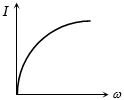
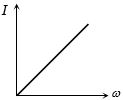
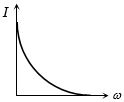
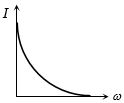
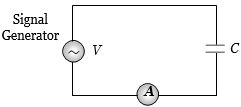
A constant voltage at different frequencies is applied across a capacitance $C$ as shown in the figure. Which of the following graphs Correctly depicts the variation of current with frequency ?
  • A


  • C

  • D

Answer

Correct option: B.

b
(b) For capacitive circuits ${X_C} = \frac{1}{{\omega C}}$

$\therefore i = \frac{V}{{{X_C}}} = V\omega C$ $ \Rightarrow i \propto \omega $

Need a full question paper?

Generate a complete, print-ready paper with questions like this in minutes — across 16+ boards, with answer keys.

Start Generating Free

Similar questions

A capacitor of capacitance $C$ is charged to a potential difference $V_0$. The charging battery is removed and the capacitor is now connected to an uncharged capacitor of unknown capacity, the potential difference across the combination becomes $V$. The unknown capacitance is
A rod of length $20$ cm is rotating with angular speed of $100$ rps in a magnetic field of strength $0.5$ T about it’s one end. What is the potential difference between two ends of the rod.......$V$
The displacement $y$ of a wave travelling in the x-direction is given by $y = {10^{ - 4}}\sin \,\,\left( {600t - 2x + \frac{\pi }{3}} \right)$ metres, where $x$ is expressed in metres and $t$ in seconds. The speed of the wave-motion, in ..... $ms^{-1}$, is
The angular momentum of electron in $n^{th}$ orbit is given by
$STATEMENT-1$ If there is no external torque on a body about its center of mass, then the velocity of the center of mass remains constant. because

$STATEMENT-2$ The linear momentum of an isolated system remains constant.

Which of the following statements about the gravitational constant is true
A solid sphere is rolling on a horizontal plane without slipping. If the ratio of angular momentum about axis of rotation of the sphere to the total energy of moving sphere is $\pi: 22$ then, the value of its angular speed will be $...........\,rad / s$.
A sonometer wire of length $114\, cm$ is fixed at both the ends. Where should the two bridges be placed so as to divide the wire into three segments whose fundamental frequencies are in the ratio $1 : 3 : 4$ ?
The persistence of sound in a room after the source of sound is turned off is called reverberation. The measure of reverberation time is the time required for sound intensity to decrease by $60 \,dB$. It is given that the intensity of sound falls off as $I_0 \exp \left(-c_1 \alpha\right)$ where $I_0$ is the initial intensity, $c_1$ is a dimensionless constant with value $1 / 4$. Here, $\alpha$ is a positive constant which depends on the speed of sound, volume of the room, reverberation time, and the effective absorbing area $A_e$. The value of $A_e$ is the product of absorbing coefficient (with value between $0$ and $1,1$ being a perfect absorber) and the area of the room. For a concert hall of volume $600 \,m ^3$, the value of $A_e$ (in $m ^2$ ) required to give a reverberation time of $1 s$ is closest to (speed of sound in air $=340 \,m / s$ )
Conduction electrons are almost uniformly distributed within a conducting plate. When placed in an electrostatic field $\overrightarrow E $, the electric field within the plate