A thin tube sealed at both ends is $100\, cm$ long. It lies horizontally, the middle $20\, cm$ containing mercury and two equal ends containing air at standard atmospheric pressure . If the tube is now turned to a vertical position, by what amount will the mercury be displaced ? (Given : cross-section of the tube can be assumed to be uniform) ........ $cm$

JEE MAIN 2013, Diffcult
Download our app for free and get started
Lengths of $M$ and $N$ are $(40-y)$ and $(40+y)$ respecively.
$P_1=$ Preessure of par $M$
$P_2=$ Pressure of part $N$
As temperature is constant
Therefore, we can write $PV =$ constant
For $M : P_0(40 A)=P_1(40-y) A$
$\Rightarrow P_1=\frac{P_0(40)}{(40-y)} \ldots \ldots .(\text { i })$
For $N : P_0(40 A)=P_2(40+y) A$
$\Rightarrow P_2=\frac{P_0 40}{(40+y)}$
Here $A=$ area of cross section of tube
Pressure at lower face $\left(P_1\right)=$ Pressure at upper face $\left(P_2\right)+$ Pressure due to mercury column of height $20 cm$.
$P_1=P_2=20 pg$
Use (i) and (ii) in (iii)
$P_0 \frac{40}{(40-y)}=\frac{P_0 40}{(40+y)}+20 p g$
$\frac{40 P_0}{(40-y)}-\frac{40 P_0}{(40+y)}=20 p g$
$40 \times 76 p g\left[\frac{2 y}{1600-y^2}\right]=20 p g$
$(52)(2 y)=1600-y^2$
$304 y=1600-y^2$
$y^2+304 y-1600=0$
Solving for $y$, we get $y=5.18\; cm$

Download our appand get started for free
Experience the future of education. Simply download our apps or reach out to us for more information. Let's shape the future of learning together!No signup needed.*
Similar Questions
- 1View SolutionThe weight of an aeroplane flying in the air is balanced by
- 2If $W$ be the weight of a body of density $\rho $ in vacuum then its apparent weight in air of density $\sigma $ isView Solution
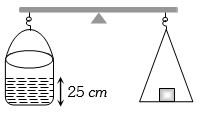
- 3A cylinder containing water up to a height of $25 cm$ has a hole of cross-section $\frac{1}{4}c{m^2}$ in its bottom. It is counterpoised in a balance. What is the initial change in the balancing weight when water begins to flow outView Solution
- 4A cubical block is floating in a liquid with one fourth of its volume immersed in the liquid. If whole of the system accelerates upward with acceleration $g / 4$, the fraction of volume immersed in the liquid will be ..........View Solution
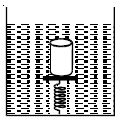
- 5A cylindrical block of area of cross-section $A$ and of material of density $\rho$ is placed in a liquid of density one-third of density of block. The block compresses a spring and compression in the spring is one-third of the length of the block. If acceleration due to gravity is $g$, the spring constant of the spring is:View Solution
- 6Density of ice is $\rho $ and that of water is $\sigma $. What will be the decrease in volume when a mass $M$ of ice meltsView Solution
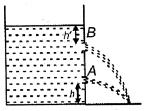
- 7A tank is filled with water and two holes $A$ and $B$ are made in it. For getting same range, ratio of $h^{\prime} T h$ is ..........View Solution
- 8An aeroplane of mass $3 \times 10^4\, kg$ and total wing area of $120\, m^2$ is in a level flight at some height. The difference in pressure between the upper and lower surfaces of its wings in kilopascals is $(g=10\,m/s^2)$View Solution
- 9An inverted bell lying at the bottom of a lake $ 47.6 m$ deep has $50$ $cm^3$ of air trapped in it. The bell is brought to the surface of the lake. The volume of the trapped air will be ......... $cm^3$ (atmospheric pressure $ = 70\,cm$ of $Hg$ and density of $Hg = 13.6$ $cm^3$)View Solution
- 10Two tubes of radii $r_1$ and $r_2$, and lengths $l_1$ and $l_2$, respectively, are connected in series and a liquid flows through each of them in streamline conditions. $P_1$ and $P_2$ are pressure differences across the two tubes. If $P_2$ is $4P_1$ and $l_2$ is $ \frac{l_1}{4}$ , then the radius $r_2$ will be equal toView Solution