A copper rod and a steel rod of equal cross-sections and lengths $(L)$ are joined side by side and connected between two heat baths as shown in the figure
If heat flows through them from $x = 0$ to $x = 2L$ at a steady rate and conductivities of the metals are $K_{cu}$ and $K_{steel}$ $(K_{cu} > K_{steel}),$ then the temperature varies as (convection and radiation are negligible)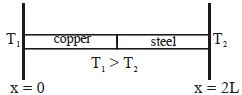
- A
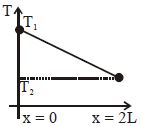
- B
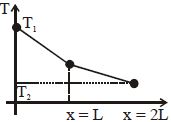
- C
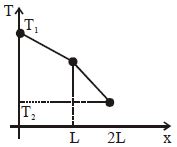
- D
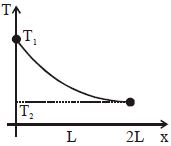
Diffcult


Download our appand get started for free
Experience the future of education. Simply download our apps or reach out to us for more information. Let's shape the future of learning together!No signup needed.*
Similar Questions
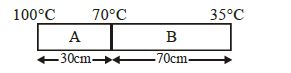
- 1For a small temperature difference between the body and the surroundings the relation between the rate of loss heat $R$ and the temperature of the body is depicted byView Solution
- 2A constant potential difference is applied to the ends of a graphite rod, whose resistance decreases with a rise of temperature. The rod can be $(1)$ covered with asbestos or $(2)$ left open to atmosphere. Answer for steady state.View Solution
- 3Wires $A$ and $B$ have identical lengths and have circular cross-sections. The radius of $A$ is twice the radius of $B$ $i.e.$ ${r_A} = 2{r_B}$. For a given temperature difference between the two ends, both wires conduct heat at the same rate. The relation between the thermal conductivities is given byView Solution
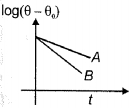
- 4Two bodies $A$ and $B$ of equal masses, area and emissivity cooling under Newton's law of cooling from same temperature are represented by the graph. If $\theta$ is the instantaneous temperature of the body and $\theta_0$ is the temperature of surroundings, then relationship between their specific heats is ..........View Solution
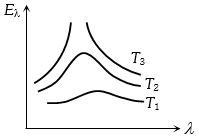
- 5View SolutionVariation of radiant energy emitted by sun, filament of tungsten lamp and welding arc as a function of its wavelength is shown in figure. Which of the following option is the correct match
- 6View SolutionAt a common temperature, a block of wood and a block of metal feel equally cold or hot. The temperatures of block of wood and block of metal are
- 7Spheres $P$ and $Q$ are uniformly constructed from the same material which is a good conductor of heat and the radius of $Q$ is thrice the radius of $P$. The rate of fall of temperature of $P$ is $x$ times that of $Q$ when both are at the same surface temperature. The value of $x$ is :View Solution
- 8View SolutionColour of shining bright star is an indication of its
- 9Five identical rods are joined as shown in figure. Point $A$ and $C$ are maintained at temperature $120^o C$ and $20^o C$ respectively. The temperature of junction $B$ will be....... $^oC$View Solution
- 10Two different rods $A$ and $B$ are kept as shown in figure. The ratio of thermal conductivities of $A$ and $B$ isView Solution