A current $i$ $ampere$ flows along an infinitely long straight thin walled tube, then the magnetic induction at any point inside the tube is
AIEEE 2004, Easy
Download our app for free and get started
Current enclosed inside the tube is equal to zero, applying ampere's law $\oint {B.dl = {\mu _0}{I_{en}}} $
$B_{i n}=0$

Download our appand get started for free
Experience the future of education. Simply download our apps or reach out to us for more information. Let's shape the future of learning together!No signup needed.*
Similar Questions
- 1A uniform magnetic field $B$ is acting from south to north and is of magnitude $1.5$ $Wb/{m^2}$. If a proton having mass $ = 1.7 \times {10^{ - 27}}\,kg$ and charge $ = 1.6 \times {10^{ - 19}}\,C$ moves in this field vertically downwards with energy $5\, MeV$, then the force acting on it will beView Solution
- 2A long solenoid of length $L$ has a mean diameter $D$. It has $n$ layers of windings of $N$ $turns$ each. If it carries a current ‘$i$’ the magnetic field at its centre will beView Solution
- 3A square current carrying loop is suspended in a uniform magnetic field acting in the plane of the loop. If the force on one arm of the loop is $\overrightarrow F$ the net force on the remaining three arms of the loop isView Solution
- 4Under the influence of a uniform magnetic field a charged particle is moving in a circle of radius $R$ with constant speed $v$. The time period of the motionView Solution
- 5View SolutionTwo wires of same length are shaped into a square and a circle. If they carry same current, ratio of the magnetic moment is
- 6To convert galvanometer into ammeter, shunt of $0.01\,\Omega $ is used. Resistance of galvanometer coil is $50\,\Omega $ and its maximum deflection current is $20\ mA$ . Range of ammeter isView Solution
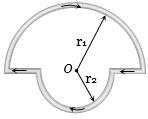
- 7In the figure shown there are two semicircles of radii ${r_1}$ and ${r_2}$ in which a current $i$ is flowing. The magnetic induction at the centre $O$ will beView Solution
- 8The region between $y = 0$ and $y = d$ contains a magnetic field $\vec B = B\hat z$ A particle of mass $m$ and charge $q$ enters the region with a velocity $\vec v = v\hat i$. If $d = \frac{{mv}}{{2qB}}$ , the acceleration of the charged particle at the point of its emergence at the other side isView Solution
- 9A particle with charge to mass ratio, $\frac{q}{m} = \alpha $ is shot with a speed $v$ towards a wall at a distance $d$ perpendicular to the wall. The minimum value of $\vec B$ that exist in this region perpendicular to the projection of velocity for the particle not to hit the wall isView Solution
- 10A coil having $100$ turns, area of $5 \times 10^{-3} \mathrm{~m}^2$, carrying current of $1 \mathrm{~mA}$ is placed in uniform magnetic field of $0.20 \mathrm{~T}$ such a way that plane of coil is perpendicular to the magnetic field. The work done in turning the coil through $90^{\circ}$ is . . . . . . $\mu \mathrm{J}$.View Solution