To convert galvanometer into ammeter, shunt of $0.01\,\Omega $ is used. Resistance of galvanometer coil is $50\,\Omega $ and its maximum deflection current is $20\ mA$ . Range of ammeter is
Medium


Download our appand get started for free
Experience the future of education. Simply download our apps or reach out to us for more information. Let's shape the future of learning together!No signup needed.*
Similar Questions
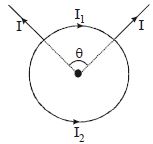
- 1Assertion : The magnetic field at the centre of the circular coil in the following figure due to the currents $I_1$ and $I_2$ is zero.View Solution
Reason : $I_1 = I_2$ implies that the fields due to the current $I_1$ and $I_2$ will be balanced.
- 2A proton (mass $ = 1.67 \times {10^{ - 27}}\,kg$ and charge $ = 1.6 \times {10^{ - 19}}\,C)$ enters perpendicular to a magnetic field of intensity $2$ $weber/{m^2}$ with a velocity $3.4 \times {10^7}\,m/\sec $. The acceleration of the proton should beView Solution
- 3At a distance of $10\, cm $ from a long straight wire carrying current, the magnetic field is $0.04\, T$. At the distance of $40\, cm$, the magnetic field will be....$T$View Solution
- 4The magnetic field due to a current carrying circular loop of radius $3\, cm$ at a point on the axis at a distance of $4\, cm$ from the centre is $54\, \mu T$. What will be its value at the centre of the loop.......$\mu T$View Solution
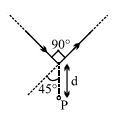
- 5Find the magnetic field at $P$ due to the arrangement shownView Solution
- 6An insulating thin rod of length $l$ has a linear charge density $\rho \left( x \right) = {\rho _0}\,\frac{x}{l}$ on it. The rod is rotated about an axis passing through the origin $(x = 0)$ and perpendicular to the rod. If the rod makes $n$ rotations per second, then the time averaged magnetic moment of the rod isView Solution
- 7View SolutionA magnetic field can be produced by
- 8View SolutionThe motion of a charged particle can be used to distinguish between a magnetic field and electric field in a certain region by firing the charge
- 9A long solenoid of radius $1\,mm$ has $100 $turns per $mm$. If $1\,A$ current flows in the solenoid, the magnetic field strength at the centre of the solenoid is:View Solution
- 10View SolutionThe tangent galvanometer, when connected in series with a standard resistance can be used as