A long solenoid of length $L$ has a mean diameter $D$. It has $n$ layers of windings of $N$ $turns$ each. If it carries a current ‘$i$’ the magnetic field at its centre will be
Easy


Download our appand get started for free
Experience the future of education. Simply download our apps or reach out to us for more information. Let's shape the future of learning together!No signup needed.*
Similar Questions
- 1View SolutionWhich particles will have minimum frequency of revolution when projected with the same velocity perpendicular to a magnetic field
- 2A particle of mass $m$ and charge $q$ moves with a constant velocity $v$ along the positive $x$ direction. It enters a region containing a uniform magnetic field $B$ directed along the negative $z$ direction, extending from $x = a$ to $x = b$. The minimum value of $v$ required so that the particle can just enter the region $x > b$ isView Solution
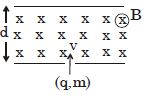
- 3View SolutionA charged particle projected in a limited magnetic field according to figure. The charged particle does not strike to the opposite plate provided
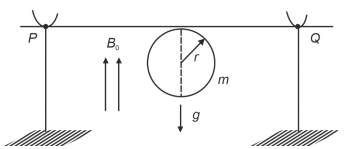
- 4A thin stiff insulated metal wire is bent into a circular loop with its two ends extending tangentially from the same point of the loop. The wire loop has mass $m$ and radius $r$ and it is in a uniform vertical magnetic field $B_0$, as shown in the figure. Initially, it hangs vertically downwards, because of acceleration due to gravity $g$, on two conducting supports at $P$ and $Q$. When a current $/$ is passed through the loop, the loop turns about the line $P Q$ by an angle $\theta$ given byView Solution
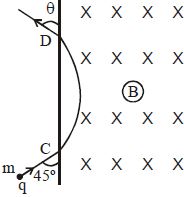
- 5A particle of mass $m = 1.67 \times 10^{-27}\, kg$ and charge $q = 1.6 \times 10^{-19} \, C$ enters a region of uniform magnetic field of strength $1$ $tesla$ along the direction shown in the figure. The speed of the particle is $10^7\, m/s.$ The magnetic field is directed along the inward normal to the plane of the paper. The particle enters the field at $C$ and leaves at $D.$ Then the angle $\theta$ must be :-.........$^o$View Solution
- 6A charged particle carrying charge $1\,\mu C$ is moving with velocity $(2 \hat{ i }+3 \hat{ j }+4 \hat{ k })\, ms ^{-1} .$ If an external magnetic field of $(5 \hat{ i }+3 \hat{ j }-6 \hat{ k }) \times 10^{-3}\, T$ exists in the region where the particle is moving then the force on the particle is $\overline{ F } \times 10^{-9} N$. The vector $\overrightarrow{ F }$ is :View Solution
- 7The cyclotron frequency of an electron grating in a magnetic field of $1\, T$ is approximatelyView Solution
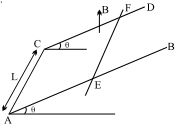
- 8$AB$ and $CD$ are smooth parallel rails, separated by a distance $l$, and inclined to the horizontal at an angle $\theta$ . $A$ uniform magnetic field of magnitude $B$, directed vertically upwards, exists in the region. $EF$ is a conductor of mass $m$, carrying a current $i$, if $B$ is normal to the plane of the railsView Solution
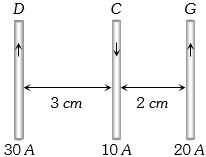
- 9Three long, straight parallel wires carrying current, are arranged as shown in figure. The force experienced by a $25\, cm$ length of wire $C$ isView Solution
- 10A current of $200\ \mu \mathrm{A}$ deflects the coil of a moving coil galvanometer through $60^{\circ}$. The current to cause deflection through $\frac{\pi}{10}$ radian is:View Solution