A current $i$ is flowing in a straight conductor of length $L.$ The magnetic induction at a point on its axis at a distance $\frac {L}{4}$ from its centre will be
JEE MAIN 2013, Medium
Download our app for free and get started
$B=\frac{\mu_{0} i}{4 \pi R}\left(\sin \theta_{1}+\sin \theta_{2}\right)$
$\sin \theta_{2}=\frac{L / 2}{\sqrt{(L / 2)^{2}+(L / 2)^{2}}}=\frac{1}{2(\sqrt{1 / 4+1 / 16})}=\frac{2}{\sqrt{5}}$
$\Rightarrow B=\frac{\mu_{0} i}{{4 \pi \frac{L}{4}}}\left(\frac{2 \times 4}{2 \sqrt{5}}\right) B=\frac{4 \mu_{0} i}{\sqrt{5} \pi L}$

Download our appand get started for free
Experience the future of education. Simply download our apps or reach out to us for more information. Let's shape the future of learning together!No signup needed.*
Similar Questions
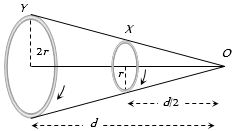
- 1Two circular coils $X$ and $Y$, having equal number of turns, carry equal currents in the same sense and subtend same solid angle at point $O$. If the smaller coil, $X$ is midway between $O$ and $Y$, then if we represent the magnetic induction due to bigger coil $Y$ at $O$ as $BY$ and that due to smaller coil $X$ at $O$ as $BX$ , thenView Solution
- 2A particle of charge $16\times10^{-16}\, C$ moving with velocity $10\, ms^{-1}$ along $x-$ axis enters a region where magnetic field of induction $\vec B$ is along the $y-$ axis and an electric field of magnitude $10^4\, Vm^{-1}$ is along the negative $z-$ axis. If the charged particle continues moving along $x-$ axis, the magnitude of $\vec B$ isView Solution
- 3A current $I$ flows along the length of an infinitely long, straight, thin walled pipe. ThenView Solution
- 4A hairpin like shape as shown in figure is made by bending a long current carrying wire. What is the magnitude of a magnetic field at point $P$ which lies on the centre of the semicircle ?View Solution

- 5In an experiment, electrons are accelerated, from rest, by applying, a voltage of $500 \,V.$ Calculate the radius of the path if a magnetic field $100\,mT$ is then applied. [Charge of the electron $= 1.6 \times 10^{-19}\,C$ Mass of the electron $= 9.1 \times 10^{-31}\,kg$ ]View Solution
- 6Two parallel, long wires are kept $0.20\,m$ apart in vacuum, each carrying current of $x$ in the same direction. If the force of attraction per meter of each wire is $2 \times 10^{-6}\,N$, then the value of $x$ is approximatelyView Solution
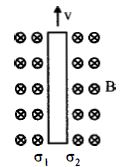
- 7Consider a thin metallic sheet perpendicular to the plane of the paper moving with speed $'v'$ in a uniform magnetic field $B$ going into the plane of the paper (See figure). If charge densities ${\sigma _1}$ and ${\sigma _2}$ are induced on the left and right surfaces, respectively, of the sheet then (ignore fringe effects)View Solution
- 8If an electron revolves around a nucleus in a circular orbit of radius $R$ with frequency $n$, then the magnetic field produced at the centre of the nucleus will beView Solution
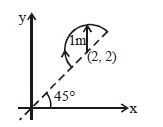
- 9A uniform magnetic field $\vec B = \left( {3\hat i + 4\hat j + \hat k} \right)$ exists in region of space. A semicircular wire of radius $1\,m$ carrying current $1\,A$ having its centre at $(2, 2, 0)$ is placed in $x-y$ plane as shown in figure. The force on semicircular wire will beView Solution
- 10A charge $+ Q$ is moving upwards vertically. It enters a magnetic field directed to the north. The force on the charge will be towardsView Solution