A hairpin like shape as shown in figure is made by bending a long current carrying wire. What is the magnitude of a magnetic field at point $P$ which lies on the centre of the semicircle ?

JEE MAIN 2021, Diffcult


Download our appand get started for free
Experience the future of education. Simply download our apps or reach out to us for more information. Let's shape the future of learning together!No signup needed.*
Similar Questions
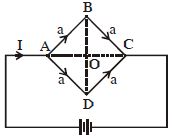
- 1Magnetic field at the centre $O$ of a square loop of side $'a'$ carrying current $I$ as shown in the figure isView Solution
- 2The current sensitivity of a moving coil galvanometer increases by $20 \%$ when its resistance is doubled. Calculate, by what factor does the voltage sensitivity change?View Solution
- 3A particle of charge per unit mass $\alpha$ is released from origin with a velocity $\bar{v}=v_0 \vec{i}$ in a uniform magnetic field $\bar{B}=-B_0 \hat{k}$. If the particle passes through $(0, y, 0)$ then $y$ is equal toView Solution
- 4A moving coil galvanometer has resistance $50\,\Omega $ and it indicates full deflection at $4\,mA$ current. A voltmeter is made using this galvanometer and a $5\,k\Omega $ resistance. The maximum voltage, that can be measured using this voltamenter, will be close to ......$V$View Solution
- 5The length of a steel wire is $L$ and its magnetic moment is $M$. On bending it into the shape of a semicircle, its’ magnetic moment will beView Solution
- 6A charge particle is moving in a uniform magnetic field $(2 \hat{i}+3 \hat{j}) T$. If it has an acceleration of $(\alpha \hat{i}-4 \hat{j}) m / s ^{2}$, then the value of $\alpha$ will be.View Solution
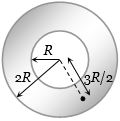
- 7Figure shows the cross-sectional view of the hollow cylindrical conductor with inner radius '$R$' and outer radius '$2R$', cylinder carrying uniformly distributed current along it's axis. The magnetic induction at point '$P$' at a distance $\frac{{3R}}{2}$ from the axis of the cylinder will beView Solution
- 8View SolutionParticles having positive charges occasionally come with high velocity from the sky towards the earth. On account of the magnetic field of earth, they would be deflected towards the
- 9Ionized hydrogen atoms and $\alpha$ -particles with same momenta enters perpendicular to a constant magnetic field $B$. The ratio of their radii of their paths $\mathrm{r}_{\mathrm{H}}: \mathrm{r}_{\alpha}$ will beView Solution
- 10View SolutionIf the direction of the initial velocity of the charged particle is neither along nor perpendicular to that of the magnetic field, then the orbit will be