A current $i$ is flowing in a straight conductor of length $L.$ The magnetic induction at a point on its axis at a distance $\frac {L}{4}$ from its centre will be
JEE MAIN 2013, Medium


Download our appand get started for free
Experience the future of education. Simply download our apps or reach out to us for more information. Let's shape the future of learning together!No signup needed.*
Similar Questions
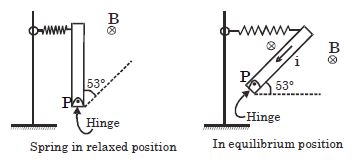
- 1A thin uniform rod with negligible mass and length $l$ is attached to the floor by a frictionless hinge at point $P$ . A horizontal spring with force constant $k$ connects the other end to wall. The rod is in a uniform magnetic field $B$ directed into the plane of paper. What is extension in spring in equilibrium when a current $i$ is passed through the rod in direction shown. Assuming spring to be in natural length initially.View Solution
- 2The magnetic moment of a current $(i)$ carrying circular coil of radius $(r)$ and number of turns $(n)$ varies asView Solution
- 3A galvanometer with its coil resistance $25\,\Omega $ requires a current of $1\,mA$ for its full deflection. In order to construct an ammeter to read up to a current of $2\,A,$ the approximate value of the shunt resistance should beView Solution
- 4A current of $200\ \mu \mathrm{A}$ deflects the coil of a moving coil galvanometer through $60^{\circ}$. The current to cause deflection through $\frac{\pi}{10}$ radian is:View Solution
- 5A coil in the shape of an equilateral triangle of side $10\, {cm}$ lies in a vertical plane between the pole pieces of permanent magnet producing a horizontal magnetic field $20\, {mT}$. The torque acting on the coil when a current of $0.2\, {A}$ is passed through it and its plane becomes parallel to the magnetic field will be $\sqrt{{x}} \times 10^{-5} \,{Nm}$. The value of ${x}$ is ..... .View Solution
- 6A charge moving with velocity $v$ in $X$-direction is subjected to a field of magnetic induction in the negative $X$-direction. As a result, the charge willView Solution
- 7To Verify Ohm's law, a student is provided with a test resistor $\mathrm{R}_{\mathrm{T}}$, a high resistance $\mathrm{R}_1$, a small resistance $\mathrm{R}_2$, two identical galvanometers $\mathrm{G}_1$ and $\mathrm{G}_2$, and a variable voltage source $\mathrm{V}$. The correct circuit to carry out the experiment isView Solution
- 8View SolutionAssertion : A charge, whether stationary or in motion produces a magnetic field around it.
Reason : Moving charges produce only electric field in the surrounding space.
- 9A metallic rod of mass per unit length $0.5\; kg\; m^{-1}$ is lying horizontally on a smooth inclined plane which makes an angle of $30^o$ with the horizontal. The rod is not allowed to slide down by flowing a current through it when a magnetic field of induction $0.25\; T$ is acting on it in the vertical direction. The current flowing in the rod to keep it stationary is.....$A$View Solution
- 10A charge $q$ is moving in a magnetic field then the magnetic force does not depend uponView Solution