MCQ
A cycle tyre bursts suddenly. This represents an
  • A
    Isothermal process
  • B
    Isobaric process
  • C
    Isochoric process
  • Adiabatic process

Answer

Correct option: D.
Adiabatic process
d
(d)The process is very fast, so the gas fails to gain or lose heat. Hence this process in adiabatic

Need a full question paper?

Generate a complete, print-ready paper with questions like this in minutes — across 16+ boards, with answer keys.

Start Generating Free

Similar questions

A satellite of mass m is circulating around the earth with constant angular velocity. If radius of the orbit is ${R_0}$ and mass of the earth M, the angular momentum about the centre of the earth is
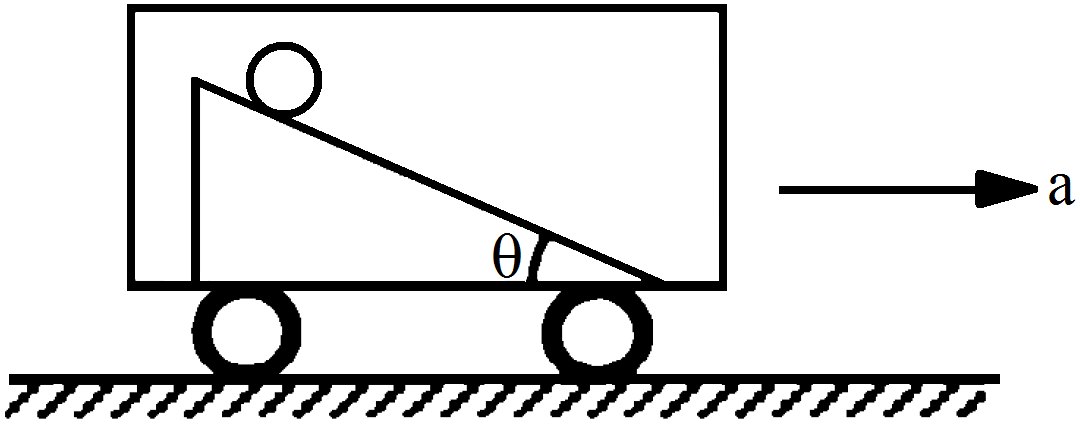
Figure shows a smooth inclined plane fixed in a car accelerating on a horizontal road. The angle of incline 0 is related to the acceleration a of the car as a = g tan°. If the sphere is set in pure rolling on the incline:
If $P, Q, R$ are physical quantities, having different dimensions, which of the following combinations can never be a meaningful quantity?
In the above question, if another body is at rest, then velocity of the compound body after collision is
The displacement of a particle moving in a straight line depends on time as $x=\alpha t^3+\beta t^2+\gamma t+\delta$.The ratio of initial acceleration to its initial velocity depends
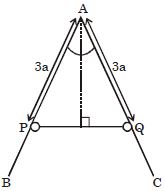
In the diagram, $BAC$ is a rigid fixed rough wire and angle $BAC$ is $60^o$. $P$ and $Q$ are two identical rings of mass $m$ connected by a light elastic string of natural length $2a$ and elastic constant $\frac{mg}{a}$. If $P$ and $Q$ are in equilibrium when $PA = AQ = 3a$ then the least coefficient of friction between the ring and the wire is $\mu$. Then value of $\mu + \sqrt 3 $ is :-
A stone tied to the end of a string of $1\, m$ long is whirled in a horizontal circle with a constant speed. If the stone makes $22$ revolution in $44\, seconds$, what is the magnitude and direction of acceleration of the stone?
A pulley of radius $2\  m$ is rotated about its axis by a force $F = (20t - 5t^2)$ newton (where $t$ is measured in second ) applied tangentially. If the moment of inertia of the pulley about its axis of rotation is $10\  kg\  m^2$, the number of rotations made by the pulley before its direction of motion is reversed, is very equal to
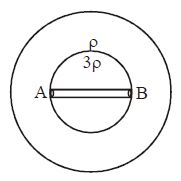
A planet of core density $3 \rho$ and outer crust of density $\rho$ has small tunnel in core. A small particle of mass $m$ is released from end $A$ then time required to reach end $B$
The moment of inertia of an object does not depend on: