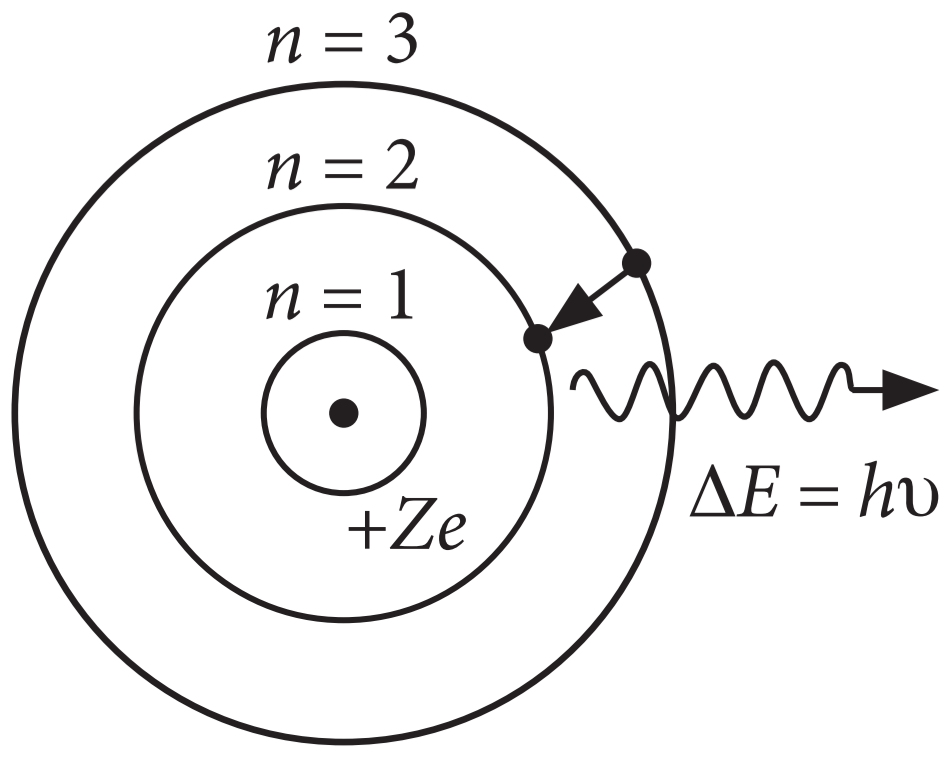
Question
Explain Bohr's atomic model.
###
State three postulates of Bohr's atomic model.

Answer

Bohr combined classical and early quantum concepts and gave his theory in the form of three postulates. These are :
(i) Bohr's first postulate :
An electron in an atom could revolve in certain stable orbits without the emission of radiant energy.
According to this postulate, each atom has certain definite stable states in which it can exist, and each possible state has definite total energy. These are called the stationary states of the atom.
This contrary to the predictions of electromagnetic theory.
(ii) Bohr's second postulate :
The electron revolves around the nucleus only in those orbits for which the angular momentum is in integral multiple of $\frac{h}{2 \pi}$.
Where, $h$ is Planck's constant
$h=6.625 \times 10^{-34} J s \text {. }$
$L =\frac{n h}{2 \pi}$ Where, $n=1,2,3 \ldots$
(iii) Bohr's third postulate :
An electron makes a transition from one of its specified non-radiating orbits to another of lower energy. When it does so, a photon is emitted having energy equal to the energy difference between the initial and final states.
The frequency of the emitted photon is then given by
$h v= E _i- E _f$
Where $E _i$ and $E _f$ are the energies of the initial and final states and $E _i> E _f$

Need a full question paper?

Generate a complete, print-ready paper with questions like this in minutes — across 16+ boards, with answer keys.
Start Generating Free

Similar questions

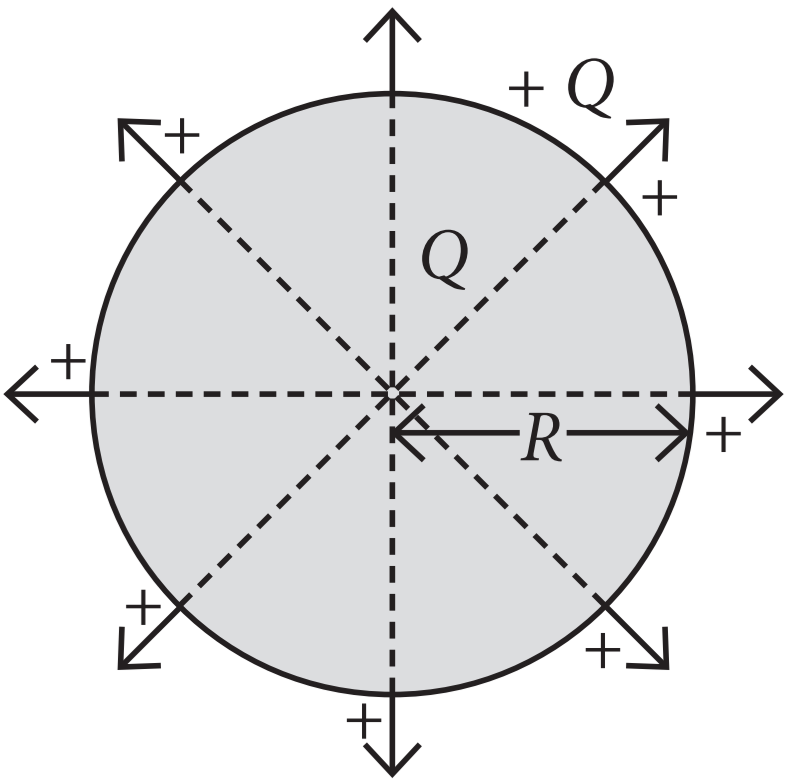
The electrical capacitance of a conductor is the measure of its ability to hold electric charge. An isolated spherical conductor of radius $R$. The charge $Q$ is uniformly distributed over its entire surface. It can be assumed to be concentrated at the centre of the sphere. The potential at any point on the surface of the spherical conductor will be $\text{V}=\frac{1}{4\pi\epsilon_0}\frac{\text{Q}}{\text{R}}.$
Capacitance of the spherical conductor situated in vacuum is $\text{C}=\frac{\text{Q}}{\text{V}}=\frac{\text{Q}}{\frac{1}{4\pi\epsilon_0}.\frac{\text{Q}}{\text{R}}}$ or $\text{C}=4\pi\epsilon_0\text{R}$ Clearly, the capacitance of a spherical conductor is proportional to its radius.
The radius of the spherical conductor of $1F$ capacitance is $\text{R}=\frac{1}{4\pi\epsilon_0}. C$ and this radius is about $1500$ times the radius of the earth $(\sim6\times10^3\text{km}).$
  1. If an isolated sphere has a capacitance $50pE$ Then radius is:
  1. $90\ cm$
  2. $45\ cm$
  3. $45m$
  4. $90m$
How much charge should be placed on a capacitance of $25 pF$ to raise its potential to $105V$?
  1. $1\mu\text{C}$
  2. $1.5\mu\text{C}$
  3. $2\mu\text{C}$
  4. $2.5\mu\text{C}$
Dimensions of capacitance is:
  1. $[M L^{-2} T^4 A^2]$
  2. $[M^{-1} L^{-1} T^3 A^1]$
  3. $[M^{- }L^{-2} T^4 A^2]$
  4. $[M^0 L^{-2} T^4 A^1]$
Metallic sphere of radius $R$ is charged to potential $V$. Then charge $q$ is proportional to:
  1. $V$
  2. $R$
  3. Both $V$ and $R$
  4. None of these
If $64$ identical spheres of charge $q $ and capacitance $C$ each are combined to form a large sphere. The charge and capacitance of the large sphere is:
  1. $64q, C$
  2. $16q, 4C$
  3. $64q, 4C$
  4. $16q, 64C$
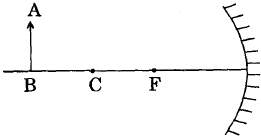
An object AB is kept in front of a concave mirror as shown in the figure.
  1. Complete the ray diagram showing the image formation of the object.
  2. How will the position and intensity of the image be affected if the lower half of the mirror's reflecting surface is painted black?
Hydrogen spectrum consists of discrete bright lines in a dark background, and it is specifically known as hydrogen emission spectrum. There is one more type of hydrogen spectrum that exists where we get dark lines on the bright background, it is known as absorption spectrum. Balmer found an empirical formula by the observation of a small part of this spectrum, and it is represented by $\frac{1}{\lambda}=\text{R}\bigg(\frac{1}{2^2}-\frac{1}{\text{n}^2}\bigg)$ where $n = 3, 4, 5$ For Lyman series, the emission is from first state to $n^{th}$ state, for Paschen series, it is from third state to $n^{th}$ state, for Brackett series, it is from fourth state to $n^{th}$ state and for $P$ fund series, it is from fifth state to $n^{th}$ state.
  1. Number of spectral lines in hydrogen atom is:
  1. $8$
  2. $6$
  3. $15$
  4. $\infty$
  1. Which series of hydrogen spectrum corresponds to ultraviolet region?
  1. Balmer series.
  2. Brackett series.
  3. Paschen series.
  4. Lyman series.
  1. Which of the following lines of the $H-$ atom spectrum belongs to the Balmer series?
  1. $1025A$
  2. $1218A$
  3. $4861A$
  4. $18751A$
  1. Rydberg constant is.
  1. A universal constant.
  2. A universal constants.
  3. Different for different elements.
  4. None of these.
  1. Hydrogen atom is excited from ground state to another state with principal quantum number equal to $4$. Then the number of spectral lines in the emission spectra will be.
  1. $3$
  2. $5$
  3. $6$
  4. $2$
A transformer is essentially an $a.c.$ device. It cannot work on $d.c.$ It changes altemating voltages or currents. It does not affect the frequency of $a.c.$ It is based on the phenomenon of mutual induction. A transformer essentially consists of two coils of insulated copper wire having different number of tums and wound on the same soft iron core.
The number of turns in the primary and secondary coils of an ideal transfonner are $2000$ and $50$ respectively. The primary coil is connected to a main supply of $120V$ and secondary coil is connected to a bulb of resistance $0.6\Omega.$
  1. The value of voltage across the secondary coil is:
  1. $5V$
  2. $2V$
  3. $3V$
  4. $10V$
  1. The value of current in the bulb is:
  1. $7A$
  2. $15A$
  3. $3A$
  4. $5A$
  1. The value of current in primary coil is:
  1. $0.125A$
  2. $2.52A$
  3. $1.51A$
  4. $3.52A$
  1. Power in primary coil is:
  1. $20W$
  2. $5W$
  3. $10W$
  4. $15W$
  1. Power in secondary coil is:
  1. $15W$
  2. $20W$
  3. $7W$
  4. $8W$
A magnetic dipole of magnetic moment $1.44A-m^2$ is placed horizontally with the north pole pointing towards north. Find the position of the neutral point if the horizontal component of the earth's magnetic field is $18 \mu\text{T}.$
Niels Bohr introduced the atomic Hydrogen model in $1913$. He described it as a positively charged nucleus, comprised of protons and neutrons, surrounded by a negatively charged electron cloud. In the model, electrons orbit the nucleus in atomic shells. The atom is held together by electrostatic forces between the positive nucleus and negative surroundings.

Bohr correctly proposed that the energy and radii of the orbits of electrons in atoms are quantized, with energy for transitions between orbits given by
$\triangle\text{E}=\text{h}\upsilon=\text{E}_\text{i}-\text{E}_\text{f}$ where $\triangle\text{E}$ is the change in energy between the initial and final orbits and $\text{h}\upsilon$ is the energy of an absorbed or emitted photon.
  1. In the Bohr model of the hydrogen atom, discrete radii and energy states result when an electron circles the atom in an integer number of
  1. De Broglie wavelengths
  2. Wave frequencies
  3. Quantum numbers
  4. Diffraction patterns.
  1. The angular speed of the electron in the $n^{th}$ orbit of Bohr's hydrogen atom is.
  1. Directly proportional to $n$
  2. Inversely proportional to $\sqrt{\text{n}}$
  3. Inversely proportional to $n^2$
  4. Inversely proportional to $n^3$
  1. When electron jumps from $n = 4$ level to $n = 1$ level, the angular momentum of electron changes by.
  1. $\frac{\text{h}}{2\pi}$
  2. $\frac{\text{h}}{\pi}$
  3. $\frac{\text{3h}}{2\pi}$
  4. $\frac{\text{2h}}{\pi}$
  1. The lowest Bohr orbit in hydrogen atom has.
  1. The maximum energy
  2. The least energy
  3. Infinite energy
  4. Zero energy
  1. Which of the following postulates of the Bohr model led to the quantization of energy of the hydrogen atom?
  1. The electron goes around the nucleus in circular orbits.
  2. The angular momentum of the electron can only be an integral multiple of $\frac{\text{h}}{2\pi}$.
  3. The magnitude of the linear momentum of the electron is quantized.
  4. Quantization of energy is itself a postulate of the Bohr model.
When a ferromagnetic material goes through a hysteresis loop, its thermal energy is increased. Where does this energy come from?
What is the difference between Magnification and Magnifying power ?
When a ferromagnetic material goes through a hysteresis loop, its thermal energy is increased. Where does this energy come from?
If the earth's magnetic field has a magnitude $3.4 \times 10^{-5} T$ at the magnetic equator of the earth what would be its value at the earth's geomagnetic poles?