A circular coil of diameter $7\,cm$ has $24$ $turns$ of wire carrying current of $ 0.75\,A$. The magnetic moment of the coil is
Easy


Download our appand get started for free
Experience the future of education. Simply download our apps or reach out to us for more information. Let's shape the future of learning together!No signup needed.*
Similar Questions
- 1A particle of mass $m$ and charge $q$ moves with a constant velocity $v$ along the positive $x$ direction. It enters a region containing a uniform magnetic field $B$ directed along the negative $z$ direction, extending from $x = a$ to $x = b$. The minimum value of $v$ required so that the particle can just enter the region $x > b$ isView Solution
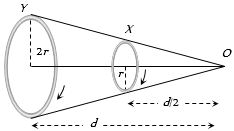
- 2Two circular coils $X$ and $Y$, having equal number of turns, carry equal currents in the same sense and subtend same solid angle at point $O$. If the smaller coil, $X$ is midway between $O$ and $Y$, then if we represent the magnetic induction due to bigger coil $Y$ at $O$ as $BY$ and that due to smaller coil $X$ at $O$ as $BX$ , thenView Solution
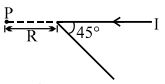
- 3A long straight wire, carrying current $I,$ is bent at its midpoint to from an angle of $45^o.$ Induction of magnetic field at point $P,$ distant $R$ from point of bending is equal to :View Solution
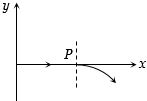
- 4For a positively charged particle moving in a $x-y$ plane initially along the $x$-axis, there is a sudden change in its path due to the presence of electric and/or magnetic fields beyond $P$. The curved path is shown in the $x-y$ plane and is found to be non-circular. Which one of the following combinations is possibleView Solution
- 5The magnetic induction in air at a point $1\,cm $ away from a long wire that carries a current of $1\,A$, will beView Solution
- 6${H^ + },\,H{e^ + }$ and ${O^{ + + }}$ ions having same kinetic energy pass through a region of space filled with uniform magnetic field $B$ directed perpendicular to the velocity of ions. The masses of the ions ${H^ + },\,H{e^ + }$and ${O^{ + + }}$ are respectively in the ratio $1:4:16$. As a resultView Solution
- 7Field at the centre of a circular coil of radius $r$, through which a current $I$ flows isView Solution
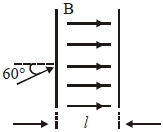
- 8The figure shows a region of length $'l'$ with a uniform magnetic field of $0.3\, T$ in it and a proton entering the region with velocity $4 \times 10^{5}\, ms ^{-1}$ making an angle $60^{\circ}$ with the field. If the proton completes $10$ revolution by the time it cross the region shown, $l$ is close to....... $m$View Solution
(mass of proton $=1.67 \times 10^{-27} \,kg ,$ charge of the proton $\left.=1.6 \times 10^{-19}\, C \right)$
- 9The region between $y = 0$ and $y = d$ contains a magnetic field $\vec B = B\hat z$ A particle of mass $m$ and charge $q$ enters the region with a velocity $\vec v = v\hat i$. If $d = \frac{{mv}}{{2qB}}$ , the acceleration of the charged particle at the point of its emergence at the other side isView Solution
- 10View SolutionAn electron is travelling in east direction and a magnetic field is applied in upward direction then electron will deflect in