A circular coil of radius $4\, cm$ and of $20$ $turns$ carries a current of $3$ amperes. It is placed in a magnetic field of intensity of $0.5$ $weber/{m^2}$. The magnetic dipole moment of the coil is.......$ampere - {m^2}$
Easy


Download our appand get started for free
Experience the future of education. Simply download our apps or reach out to us for more information. Let's shape the future of learning together!No signup needed.*
Similar Questions
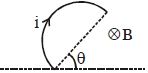
- 1A semicircular ring of radius $R$ carrying current $i$ is placed in a magnetic field of intensity $B$ so that plane of wire is perpendicular to magnetic field as shown. Net force acting on the ring isView Solution
- 2A proton and an $\alpha -$ particle (with their masses in the ratio of $1 : 4$ and charges in the ratio of $1:2$ are accelerated from rest through a potential difference $V$. If a uniform magnetic field $(B)$ is set up perpendicular to their velocities, the ratio of the radii $r_p : r_{\alpha }$ of the circular paths described by them will beView Solution
- 3A charge $Q$ is moving $\overrightarrow{dl}$ distance in the magnetic field $\overrightarrow{ B }$. Find the value of work done by $\overrightarrow{ B }$.View Solution
- 4Two long parallel copper wires carry currents of $5\,A$ each in opposite directions. If the wires are separated by a distance of $0.5\,m$, then the force between the two wires isView Solution
- 5View Solution“On flowing current in a conducting wire the magnetic field produces around it.” It is a law of
- 6An imaginary north pole of $10\,Am$ is rotating around an infinite long current carrying wire with $30\,revolution/min.$ on circular path. If current in wire is $5\,A$ then workdone in one second in doing soView Solution
- 7Assertion : A proton and an alpha particle having the same kinetic energy are moving in circular paths in a uniform magnetic field. The radii of their circular paths will be equal.View Solution
Reason : Any two charged particles having equal kinetic energies and entering a region of uniform magnetic field $\overrightarrow B $ in a direction perpendicular to $\overrightarrow B $, will describe circular trajectories of equal radii.
- 8View SolutionA loop of irregular shape carrying current is located in an external magnetic field. If wire is flexible it will take the shape of
- 9A galvanometer whose resistance is $120\,\Omega $ gives full scale deflection with a current of $0.05\, A$ so that it can read a maximum current of $10\, A$. A shunt resistance is added in parallel with it. The resistance of the ammeter so formed is .............. $\Omega $View Solution
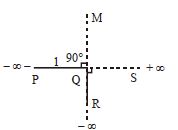
- 10An infinitely long conductor $PQR$ is bent to from a right angle as shown. A current $I$ flows through $PQR$ . The magnetic field due to this current at the point $M$ is $H_1$ . Now, another infinitely long straight conductor $QS$ is connected at $Q$ so that the current in $PQ$ remaining unchanged. The magnetic field at $M$ is now $H_2$ . The ratio $H_1/H_2$ is given byView Solution