A circular current carrying coil has a radius $R$. The distance from the centre of the coil on the axis where the magnetic induction will be $\frac{1}{8}^{th}$ to its value at the centre of the coil, is
Diffcult
Download our app for free and get started
(b) $\frac{{{B_{centre}}}}{{{B_{axis}}}} = {\left( {1 + \frac{{{x^2}}}{{{R^2}}}} \right)^{3/2}},$
also ${B_{axis}} = \frac{1}{8}{B_{centre}}$
$ \Rightarrow \frac{8}{1} = {\left( {1 + \frac{{{x^2}}}{{{R^2}}}} \right)^{3/2}} \Rightarrow 2 = {\left( {1 + \frac{{{x^2}}}{{{R^2}}}} \right)^{1/2}}$
$ \Rightarrow 4 = 1 + \frac{{{x^2}}}{{{R^2}}} \Rightarrow 3 = \frac{{{x^2}}}{{{R^2}}} \Rightarrow {x^2} = 3{R^2}$$ \Rightarrow x = \sqrt 3 R$

Download our appand get started for free
Experience the future of education. Simply download our apps or reach out to us for more information. Let's shape the future of learning together!No signup needed.*
Similar Questions
- 1Two ions having masses in the ratio $1 : 1$ and charges $1 : 2$ are projected into uniform magnetic field perpendicular to the field with speeds in the ratio $2 : 3$. The ratio of the radii of circular paths along which the two particles move isView Solution
- 2To Verify Ohm's law, a student is provided with a test resistor $\mathrm{R}_{\mathrm{T}}$, a high resistance $\mathrm{R}_1$, a small resistance $\mathrm{R}_2$, two identical galvanometers $\mathrm{G}_1$ and $\mathrm{G}_2$, and a variable voltage source $\mathrm{V}$. The correct circuit to carry out the experiment isView Solution
- 3A charged particle is moving with velocity $v$ in a magnetic field of induction $B$. The force on the particle will be maximum whenView Solution
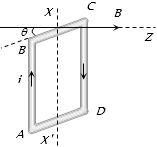
- 4The square loop $ABCD$, carrying a current $i$, is placed in uniform magnetic field $B$, as shown. The loop can rotate about the axis $XX$'. The plane of the loop makes and angle $\theta$ ($\theta$ $< 90^o$) with the direction of $B$. Through what angle will the loop rotate by itself before the torque on it becomes zeroView Solution
- 5Ionized hydrogen atoms and $\alpha$ -particles with same momenta enters perpendicular to a constant magnetic field $B$. The ratio of their radii of their paths $\mathrm{r}_{\mathrm{H}}: \mathrm{r}_{\alpha}$ will beView Solution
- 6A uniform magnetic field $B$ is acting from south to north and is of magnitude $1.5$ $Wb/{m^2}$. If a proton having mass $ = 1.7 \times {10^{ - 27}}\,kg$ and charge $ = 1.6 \times {10^{ - 19}}\,C$ moves in this field vertically downwards with energy $5\, MeV$, then the force acting on it will beView Solution
- 7An $\alpha$ particle is moving along a circle of radius $R$ with a constant angular velocity $\omega $. Point $A$ lies in the same plane at a distance $2R$ from the centre. Point $A$ records magnetic field produced by $\alpha$ particle. If the minimum time interval between two successive times at which $A$ records zero magnetic field is $‘t’,$ find the angular speed $\omega $, in terms of $t.$View Solution
- 8The pole strength of a bar magnet is $48$ $ampere-metre$ and the distance between its poles is $ 25 \,cm$ . The moment of the couple by which it can be placed at an angle of $30°$ with the uniform magnetic intensity of flux density $0.15 $ $Newton /ampere-metre$ will be.......$Newton × metre$View Solution
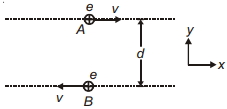
- 9Two protons $A$ and $B$ move parallel to the $x$-axis in opposite directions with equal speeds $v$. At the instant shown, the ratio of magnetic force and electric force acting on the proton $A$ is ( $c=$ speed of light in vacuum)View Solution
- 10A particle having the same charge as of electron moves in a circular path of radius $0.5View Solution
\,cm$ under the influence of a magnetic field of $0.5\,T.$ If an electric field of $100\,V/m$ makes it to move in a straight path, then the mass of the particle is (given charge of electron $= 1.6 \times 10^{-19}\, C$ )