Two ions having masses in the ratio $1 : 1$ and charges $1 : 2$ are projected into uniform magnetic field perpendicular to the field with speeds in the ratio $2 : 3$. The ratio of the radii of circular paths along which the two particles move is
Medium
Download our app for free and get started
(a) $r = \frac{{mv}}{{qB}} \Rightarrow \frac{{{r_1}}}{{{r_2}}} = \frac{{{m_1}{v_1}}}{{{m_2}{v_2}}} \times \frac{{{q_2}}}{{{q_1}}} = \frac{{1 \times 2}}{{1 \times 3}} \times \frac{2}{1} = \frac{4}{3}$

Download our appand get started for free
Experience the future of education. Simply download our apps or reach out to us for more information. Let's shape the future of learning together!No signup needed.*
Similar Questions
- 1Two ions having same mass have charges in the ratio $1: 2$. They are projected normally in a uniform magnetic field with their speeds in the ratio $2: 3$. The ratio of the radii of their circular trajectories is -View Solution
- 2View SolutionAssertion : A charge, whether stationary or in motion produces a magnetic field around it.
Reason : Moving charges produce only electric field in the surrounding space.
- 3View SolutionA charged particle is released from rest in a region of uniform electric and magnetic fields which are parallel to each other. The particle will move on a
- 4An electron accelerated through a potential difference $V$ enters a uniform transverse magnetic field and experiences a force $F$. If the accelerating potential is increased to $2V$, the electron in the same magnetic field will experience a forceView Solution
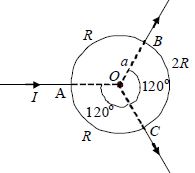
- 5The resistances of three parts of a circular loop are as shown in the figure. The magnetic field at the centre $O$ is :-View Solution
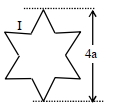
- 6A symmetric star conducting wire loop is carrying a steady state current $\mathrm{I}$ as shown in figure. The distance between the diametrically opposite vertices of the star is $4 a$. The magnitude of the magnetic field at the center of the loop isView Solution
- 7A small coil of $N$ $turns$ has an effective area $A$ and carries a current $I$. It is suspended in a horizontal magnetic field $\overrightarrow B $ such that its plane is perpendicular to $\overrightarrow B $. The work done in rotating it by $180^\circ $ about the vertical axis isView Solution
- 8The magnetic field at the center of current carrying circular loop is $B _{1}$. The magnetic field at a distance of $\sqrt{3}$ times radius of the given circular loop from the center on its axis is $B_{2}$. The value of $B_{1} / B_{2}$ will be.View Solution
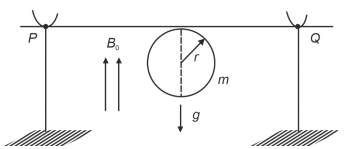
- 9A thin stiff insulated metal wire is bent into a circular loop with its two ends extending tangentially from the same point of the loop. The wire loop has mass $m$ and radius $r$ and it is in a uniform vertical magnetic field $B_0$, as shown in the figure. Initially, it hangs vertically downwards, because of acceleration due to gravity $g$, on two conducting supports at $P$ and $Q$. When a current $/$ is passed through the loop, the loop turns about the line $P Q$ by an angle $\theta$ given byView Solution
- 10A proton of mass $m$ and charge $+e$ is moving in a circular orbit in a magnetic field with energy $1\, MeV$. What should be the energy of $\alpha - $particle (mass = $4m$ and charge = $+ 2e),$ so that it can revolve in the path of same radius.......$MeV$View Solution